Q1 2026 Automotive Industry Outlook

This Could be a Tipping Point
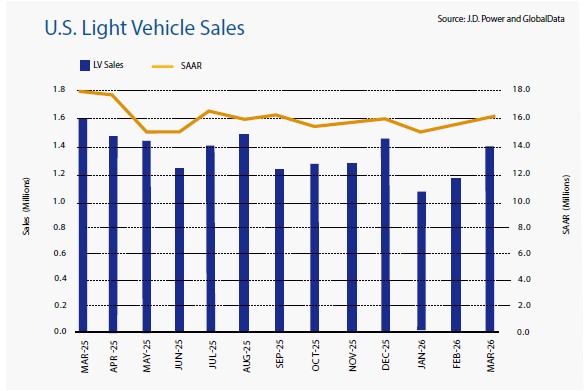
April 2026 – The year got off to a slow start in January due to severe weather in the final two weeks of the month. From a seasonal perspective, sales in January are among the weakest but this was the first time in two years that the seasonally adjusted annualized rate fell below 15 million vehicles. The rate of sales improved in February and March but any comparison to Q1 of 2025 was always going to be difficult. Faced with the prospect of higher tariffs, anyone in the market for a new vehicle at that time was better off advancing their purchase ahead of the April 3, 2025 deadline. Even with the subsequent lift in sales, the SAAR for the first quarter was only 15.5 million vehicles. That, together with the war in Iran, has prompted industry analysts to trim their full-year forecasts by 200,000 – 300,000 vehicles. Current forecasts are clustered around 16.0 million vehicles.
At the outset of the year, GasBuddy was forecasting the yearly national average price of gasoline to fall back below $3 per gallon for the first time since the global pandemic. The world had finally recovered from the shock of Russia’s invasion of Ukraine and GasBuddy believed average gas prices below $3 per gallon could become commonplace assuming the market avoids any major surprises. The outbreak of war with Iran triggered significant volatility in global oil markets. The straits of Hormuz, where 20% of global oil supply flows has been closed and various oil assets in the region have been destroyed or damaged. The industry was operating at near capacity before the conflict and the damage to the oil infrastructure will only make it more difficult to recover. In addition to the war damage, more than 100 full tankers are already waiting for the Straits to open, and with no available storage in the meantime, producers are being forced to moth-ball capacity. As one can imagine the effort to restart the wells is significantly more time consuming than shutting them down. As a result, it could take at least two years for the oil industry to recover from the effects of the war.
Some economists are drawing parallels to the oil embargo of the 1970’s. Determined to reduce the Country’s dependence on foreign oil, successive administrations sought to reduce domestic demand by implementing a national 55 mile per hour speed limit, extending day light savings time, and rationing fuel to the airline industry. Most of these measures have since been rescinded as domestic production has risen to meet demand. One of those measures, referred to as the Corporate Average Fuel Economy (CAFÉ) standards, remains in effect to this day and has had a lasting impact on the automotive industry. To encourage domestic manufacturers to produce more fuel efficient vehicles, companies that sold vehicles that were on average more fuel efficient than the standard were issued credits that could be sold to companies that failed to meet the standard. To avoid paying the penalties, domestic automobile manufacturers introduced smaller, front-wheel drive cars powered by smaller displacement, four cylinder engines.
The winners in the aftermath of the last great oil shock were the oil industry and the consumer. Since 2019, the U.S. oil industry has been a net exporter of oil which means it is no longer dependent on foreign oil, particularly oil from the middle east. For the consumer, there have been any number of technological advancements spurred on by the CAFÉ standards that have enabled American consumers to continue to enjoy their much loved large people movers, now called sport utility vehicles or SUVs. At the time of the 1973 oil embargo, average fuel economy for a large SUV vehicle was at best 10 miles per gallon. That same vehicle today is more than twice as fuel-efficient while being laden with a whole lot more creature comforts. Nearly every manufacturer currently offers a smaller car and/or SUV that has gas mileage in excess of 40 miles per gallon. For comparison that equates to about $0.10 per mile using the current average of $4.11 per gallon of gasoline. In a 1973 International Travelall getting 10 miles per gallon that equates to more than $0.40 per mile. At only 10 miles per gallon and $4.11 per gallon, the annual fuel bill for a 1973 International Travelall would be $5,550. Today’s hybrid vehicles averaging at least 40 miles per gallon would only cost $1,400 in fuel annually under similar conditions.
In the wake of the last oil shock, the price of oil did recede but never to the levels prior to the oil embargo, at least not for an extended period of time. As a result, other methods of oil production like fracking became more economical leading the way to oil independence. Although it is way too early to draw any conclusions, there is growing concern in the industry that when the market resets it will be at a level higher than recent history. If that is the case, the next winner in the evolution of the global energy market may be renewable energy and all that it encompasses, wind turbines, solar panels, energy storage, and electric vehicles. Years of research have been invested in this space to drive down the cost while driving up the performance. A sustained increase in the cost of fossil fuels like oil could be the tipping point that elevates the renewable energy industry from development to deployment. In an environment of high gas prices, electric vehicles would no longer garner the highest sales incentives enabling manufacturers to earn a sustainable margin from their sales. In an environment of high gas prices, homeowners may be more compelled to deploy solar panels without the assistance of government subsidies and struggling public rapid transit systems may attract sufficient ridership to support their operating expense.

The views and opinions expressed are provided for general informational and educational purposes only and are subject to change without notice. This publication does not constitute investment, tax, or legal advice, nor should it be relied upon as a recommendation regarding any course of action. The information contained herein is provided “as is” without any representations or warranties as to its accuracy, adequacy, or completeness. While Hilco Trading, LLC has exercised reasonable care in preparing this publication, it assumes no liability for any actions taken or not taken based on its contents. Past performance is not indicative of future results.