
Beyond the Banks: The Rise of Agile, Specialized Capital

September 2025
In today’s U.S. lower-middle-market (LMM) credit space, opportunities lie not in abundant capital, but in deploying it strategically when traditional banks cannot or will not lend. Here’s why: The LMM credit environment is undergoing a structural reset — not systemic insolvency.
While interest rates have eased from 2023 peaks, liquidity remains tight, and many traditional lenders are broadening their approach to include more structured solutions. Companies that took on debt in the ultra-accommodative cycle of 2020–20211 now face covenant breaches, refinancing hurdles, and stricter underwriting. In fact, speculative‑grade maturities are forecast to exceed investment‑grade by 2027.2
So, what does this reset mean in practice? We’ve found that:
- A significant tranche of sponsor-backed and family-owned businesses under $300 million in revenue are finding it increasingly difficult to refinance, even when operations remain sound.
- Many of these companies are concentrated in industrials (including commercial real estate)3, logistics4, and healthcare — sectors struggling with a mismatch of capital, not bankruptcy.5
- Shifting trade tensions and supply‑chain realignments are adding complexity. This is especially important as global trade shifts from a focus on low cost-efficiency to strategic interdependence.6
Among private credit investors, success in the next cycle will be defined by those who combine flexible capital with operational expertise to execute transactions that stabilize performance, preserve enterprise value, and unlock long-term growth.
This paper examines how credit dislocation can be reframed as a window for creating value — for both distressed companies and healthy businesses at strategic inflection points.
Credit Tightening Disproportionately Impacting Smaller Borrowers
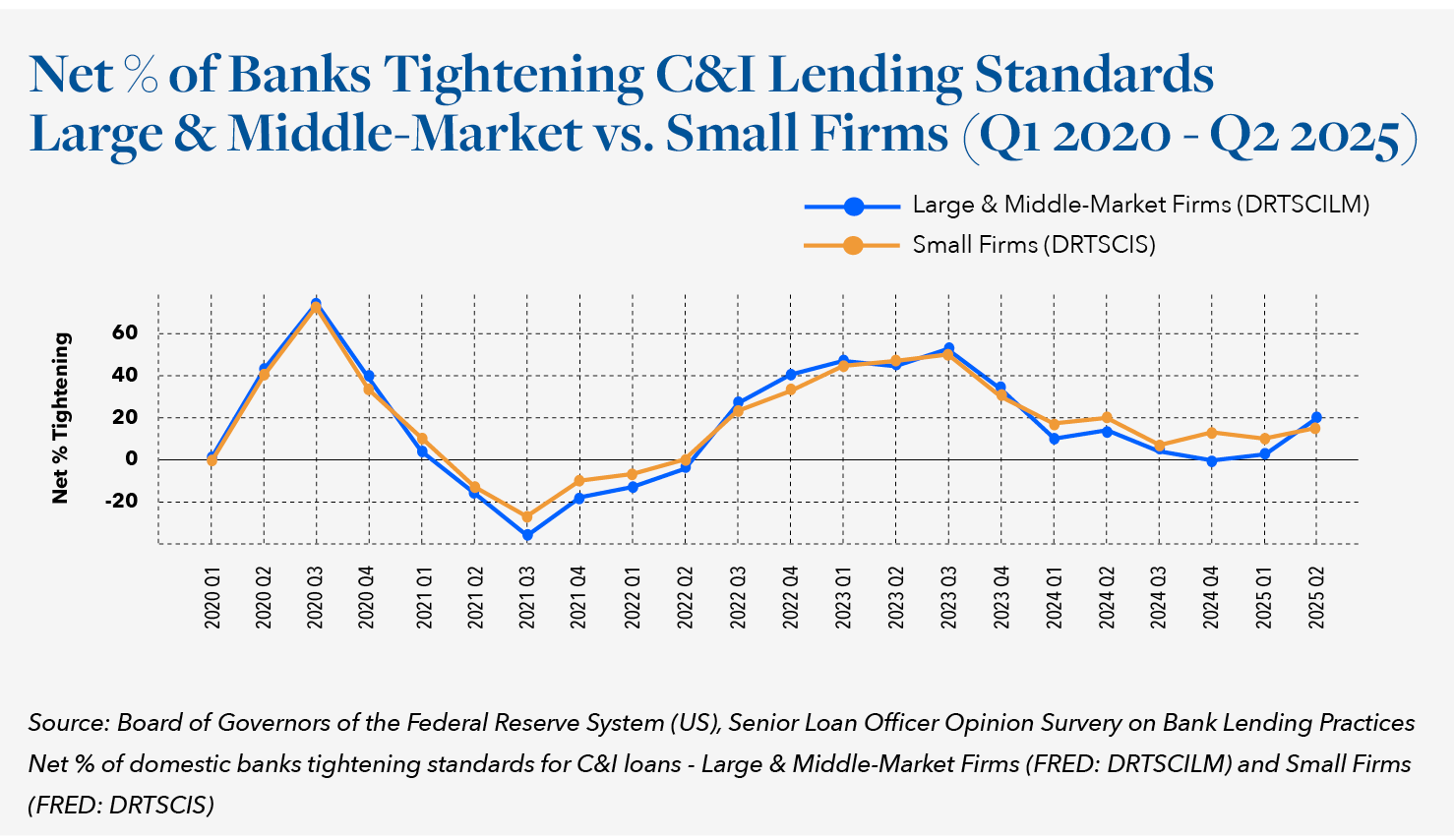
Federal Reserve data reveals that credit tightening is far from uniform across the market. Since early 2020, both large and middle-market borrowers and small firms have experienced sharp swings in credit availability, but the intensity and timing have varied. The tightening of credit standards has left LMM companies relatively underserved.7
As the chart below illustrates, small firms have generally faced equal or greater net tightening than their large and middle-market counterparts, reflecting a more acute sensitivity to changes in bank risk appetite.
From Liquidity Glut to Selective Deployment
The era of cheap and abundant capital in 2020–2021 left many LMM companies with debt overhangs. This has created a market of “haves” and “have-nots”: companies with perfect credit can still access capital, while those with even modest performance volatility are shut out or limited from accessing bank capital.
For private credit providers, this means that good LMM companies with bad balance sheets face unique recapitalization options — not because of impaired fundamentals, but because of structural capital access limits. This ultimately creates opportunities for well-capitalized lenders that understand how to underwrite the various situations that a LMM company may encounter (particularly if they are engaged early in the process).
The liquidity gap is most evident across two key types of businesses:
- Distressed-but-viable companies: These firms may struggle to refinance due to leverage or covenant restrictions. Especially in situations where the borrower has floating-rate debt, they require more than capital — strategic involvement is needed, including asset monetization, operational restructuring, or interim management to restore lender confidence.
- Healthy, growing companies: These firms may need flexible financing for expansion, acquisitions, or supply chain changes. Creative structures like revenue-based financing, structured equity, or unitranche solutions can provide a growth runway without overleveraging or diluting ownership.
What’s clear is that both kinds of businesses need lenders that are willing to move beyond rigid underwriting to match capital structures with more carefully measured risk profiles.
Opportunity in a Structural, Not Systemic, Reset
Unlike systemic crises that impair much of the economy, today’s credit challenges are concentrated in specific segments and borrower profiles. Notably, industrials (especially commercial real estate), logistics, and healthcare are navigating post-pandemic supply chain realignments, labor shortages, and margin pressures. While operationally sound, many of these businesses lack the balance sheet resilience to absorb higher debt service without limiting growth.
This distinction matters, because private credit providers can either make well-structured, asset-backed deals that offer good returns with limited risk, or they can make poorly structured deals regardless of the overall health of the business or industry vertical. Success requires being selective — and targeting situations where operational value creation is achievable within a provider’s underwriting horizon.
Execution Barriers Are Keeping Viable Transactions Undercapitalized
Private credit providers often pass on viable opportunities because:
- Collateral packages span multiple asset types and require specialized valuation.
- Operational uncertainty clouds performance forecasts.
- Timelines are compressed, creating pressure for rapid diligence and funding.
Without the right operational and valuation support, these deals can appear too risky, leaving value on the table for both the borrower and the lender. Ultimately, success in this environment requires a more sophisticated approach to underwriting — one that goes beyond traditional collateral and cash flow analysis.
Today’s private credit investors must also consider cap-stack composition, investor alignment, and potential liquidity events, combining financial insight with operational foresight to confidently execute transactions others might pass over.
Turning Cross-Border Complexity Into a Competitive Edge
Private credit doesn’t operate in a vacuum. It’s important to note that reshoring, trade realignment, and regulatory divergence can complicate cross-border credit investing. For international firms operating in or supplying U.S. markets, this dislocation is both a threat and an opportunity.
Volatile demand forecasting, inventory shifts, and surging tariffs require nimble financial strategies and precise asset-level risk assessment.8 We believe that private credit investors need to work with credit specialists who have localized, sector-specific insights, understand changing regulations, and can offer sophisticated asset valuation skills.
From ‘Pass’ to ‘Close’: Making the Impossible Work
In today’s LMM market, the ideal credit partner is one who can rapidly evaluate opportunities, identify operational levers for improvement (when and if appropriate), and deploy capital with both speed and certainty.
Hilco Global combines proprietary capital with sector-specific expertise in asset valuation, monetization, and restructuring. We’re organized to help our clients manage opportunities across the performance spectrum — from executing complex rescue financings for distressed borrowers to structuring creative growth capital solutions for healthy companies at strategic inflection points.
A New Standard for Private Credit Success
We believe that for the foreseeable future, market participants will favor private credit providers who move beyond simply providing capital. The key to success is delivering integrated solutions that address both sides of the borrower’s balance sheet — the financial and the operational. By focusing on sectors with structural capital misalignments, applying rigorous asset-based underwriting, and structuring flexible, creative transactions, private credit investors can leverage the scarcity of traditional bank financing to pursue compelling, controlled returns.
In other words, the next cycle will reward those who combine patience, flexibility, and operational insight — investors who can see the full picture and act decisively where others see risk.
Sources:
1 “Corporate borrowers squeezed by rising rates,” APnews.com, March 9, 2023. https://apnews.com/article/corporate-debt-economy-inflation-interest-rates-c448df0dde9302205207240dfeac61bf
2 “US corporate defaults on private debt rose in Q2 (2025), Fitch says,” Reuters.com, August 11, 2025. https://www.reuters.com/business/us-corporate-defaults-private-debt-rose-q2-fitch-says-2025-08-11
3 “Direct Lenders Face Rising Default Risks, Analysis Firm KBRA Says,” The Wall Street Journal, February 4, 2025. https://www.wsj.com/articles/direct-lenders-face-rising-default-risks-analysis-firm-kbra-says-41b8b787
4 Capstone Partners, “Warehousing & Fulfillment Market Update, April 2025. https://www.capstonepartners.com/insights/report-warehousing-and-fulfillment-market-update
5 CEPRES (cited in original paper as one of a number of possible data sources for this claim but didn’t include a specific footnote).
6 John Waldron, “Strategic interdependence is rewiring the global economy,” Financial Times, 12 August 2025. https://www.ft.com/content/25ab5e71-6ae2-495b-bf06-6fd2f1cbb18a
7 Federal Reserve’s Senior Loan Officer Opinion Survey (SLOOS), July 2025 (Date of Release: July 29, 2025.)
8 “The global supply chain’s reaction to the Trump tariffs: Crash, maneuver & stand by,” Reuters.com, 14 April 2025. https://www.thomsonreuters.com/en-us/posts/corporates/supply-chains-reaction-tariffs


