Inventory Turns Continue to Slow
October 2026
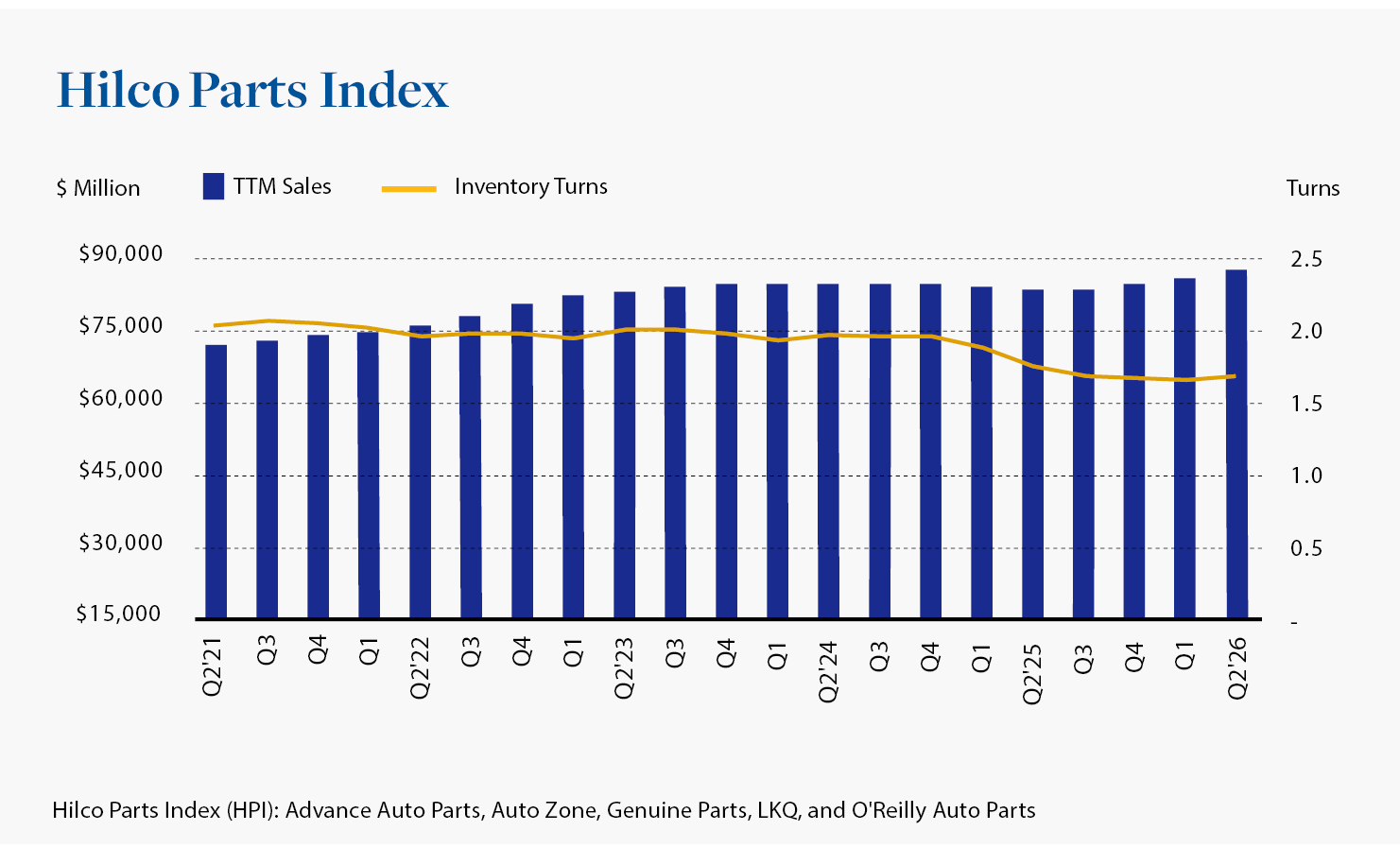
Net sales for the five companies that comprise the Hilco Parts Index were $21.7 billion for the second quarter of 2026, an increase of 4.2% from the prior year. The same is true for the trailing 12 months ending with the second quarter of 2026. Initially, second-quarter sales were about as expected, with unusually cool spring weather offset by the usual lift from tax refunds. However, the cold and wet weather lingered longer than normal, delaying sales of hot-weather categories such as batteries, starter motors and solenoids, compressors, and chemicals (antifreeze and freon).
The industry thrives on extreme weather in all its forms. Extreme heat, extreme cold, and vicious storms all serve to accelerate part failures. In the absence of the usual warming trend that begins in June, same-store sales steadily weakened as the second quarter progressed. Same-store sales, sometimes referred to as organic sales, are sales from stores that have been open for a minimum of 12 months. Reported same-store sales ranged from flat (Advance) to mid-single digits (O’Reilly). In all cases, same-store sales did not meet corporate expectations and, in most cases, were less than inflation. However, by the time companies began releasing second-quarter earnings, the much anticipated hot weather finally arrived and most companies reported favorable sales results for July. Because of its unique fiscal calendar, AutoZone reported fourth-quarter results on September 22, 2026. AutoZone’s net sales for its fourth quarter, a 16-week period that ended on August 31, 2026, were $6.6 billion, an increase of 5.6% from the fourth quarter of fiscal 2025, with same-store sales up 1.6%. Although the results did not meet AutoZone’s expectations, management was encouraged by performance late in the quarter and looked to maintain that momentum into the first quarter.
While sales appear to be resuming their steady climb upward, inventory turns appear to be moving nonetheless in the opposite direction. About 80% of the aftermarket business involves delivering parts to repair shops with a vehicle on a hoist. The industry refers to this as the commercial, or “do-it-for-me” (DIFM), channel. Customers can be fleet operators with maintenance shops that keep their vehicles rolling or independent repair shops with one or more repair bays. Most of the industry’s business involves this latter group, often referred to as “up and down the street” customers. Once on a lift, the ailing vehicle is diagnosed and the owner is given an estimate of the cost of repairs. The longer the vehicle is on the hoist, the less money the shop owner makes and the more impatient the customer becomes. To minimize wait time, parts are often ordered before approval is granted. Each company in the Hilco Parts Index has delivery vehicles assigned to stores that make on-demand deliveries called “hot shot” runs. Not long ago, the expectation was that parts could be delivered anywhere within a 10- to 15-mile radius within 45 minutes of placing the order. The expectation is now closer to 30 minutes.
To meet customer expectations for availability and on-time delivery, the industry has been rebalancing networks to locate more inventory closer to customers. It used to be that a multi-state region with 100 or more stores (spokes) would be serviced by a single, centrally located warehouse (hub) in what is referred to as a “hub-and-spoke” distribution network. Each store received one or more stock-replenishment orders a week, depending on the size (revenue) of the store and its distance from the hub. To locate more inventory closer to the customer, certain stores are designated to hold a wider assortment of inventory; some companies refer to these as “mega stores.” In a traditional hub-and-spoke distribution network, a typical store holds about 35,000 different part numbers ($750,000), while the hub (warehouse) holds about 250,000 part numbers ($15 million). Today’s iteration of the old hub-and-spoke network looks more like a family tree, where the hub is responsible for replenishing the mega stores, which in turn replenish multiple stores within a 25-mile radius. To meet customer expectations, these mega stores typically hold at least $1.5 million of inventory spanning 100,000 different part numbers.
The net result has been an increase in the amount of inventory in the system and a gradual erosion in inventory turns. The industry’s inventory turns, defined as cost of goods sold for the trailing 12 months divided by net inventory, hovered around 2.0 for years. Inventory turns dropped below 2.0 in the first quarter of 2025 and have remained there since. They are currently hovering around 1.8. Customer expectations for on-time delivery can be expected to grow, which will continue to put pressure on inventory turns. Slower inventory turns come with a cost, and that will need to be addressed longer term. The industry may offset that cost through higher gross margins, but more likely we may see further industry consolidation. Advance Auto recently sold Worldpac, and Genuine Parts has announced its interest in selling its auto parts business (NAPA) to allow it to concentrate on its industrial distribution business.
About the Index: The Hilco Parts Index comprises five publicly traded companies that distribute aftermarket parts: Advance Auto Parts (Advance), AutoZone, Genuine Parts (NAPA), LKQ, and O’Reilly Auto Parts (O’Reilly). Advance, AutoZone, NAPA, and O’Reilly are the four traditional parts distributors in North America with strong commercial (do-it-for-me, or DIFM) and retail (do-it-yourself, or DIY) programs. LKQ is largely a distributor of aftermarket collision-specific parts and recycled (used) parts.