The 2026 Iran War and Its Expanding Impact on U.S. Grocery and Fertilizer Prices

April 2026
The conflict in Iran that escalated in early 2026 is starting to show up in places most consumers don’t immediately connect to geopolitics; namely, the grocery store. While energy markets tend to react first to events in the Middle East, what is unfolding now is broader, with disruption hitting key inputs such as fuel, fertilizer, and global shipping at the same time. These pressures are working their way through the agricultural system with very real consequences for food pricing in the U.S.
What’s occurring now is also different from the post-pandemic period because this is not demand-driven inflation. Core inputs are becoming more expensive, harder to source, or both. Historically, when that combination takes hold, its impact on food prices tends to linger well beyond the initial shock, as seen in prior commodity cycles such as the 2007/2008 food price surge, according to the Food and Agriculture Organization (FAO).
A Bottleneck With Global Consequences
At the center of the issue is the Strait of Hormuz, a narrow but critical shipping lane that handles a significant share of the world’s oil exports. The U.S. Energy Information Administration (EIA) estimates that roughly one-fifth of global petroleum liquids flows through this corridor. When disruption hits that channel, energy markets react quickly.
But oil is only part of the story. These routes are also critical for fertilizer flows, particularly nitrogen-based products like ammonia and urea that originate in or move through the Middle East. According to UNCTAD, a substantial share of global seaborne fertilizer trade passes through key chokepoints in the region, making it highly sensitive to disruptions.
As the conflict has intensified, shipping companies have faced higher insurance costs, security risks, and the need to reroute vessels. Reporting from Bloomberg and the Wall Street Journal has noted that some carriers are diverting around the Cape of Good Hope, adding significant transit time and fuel consumption. These added costs move through the supply chain rather than remaining isolated within shipping.
Fertilizer: Where the Impact Shows Up First
If there is one place where the effects of these developments have been immediate, it’s fertilizer. Nitrogen fertilizers are especially sensitive because they rely heavily on natural gas and global trade flows. The FAO has repeatedly noted that ammonia-based fertilizers are structurally tied to energy prices, particularly natural gas.
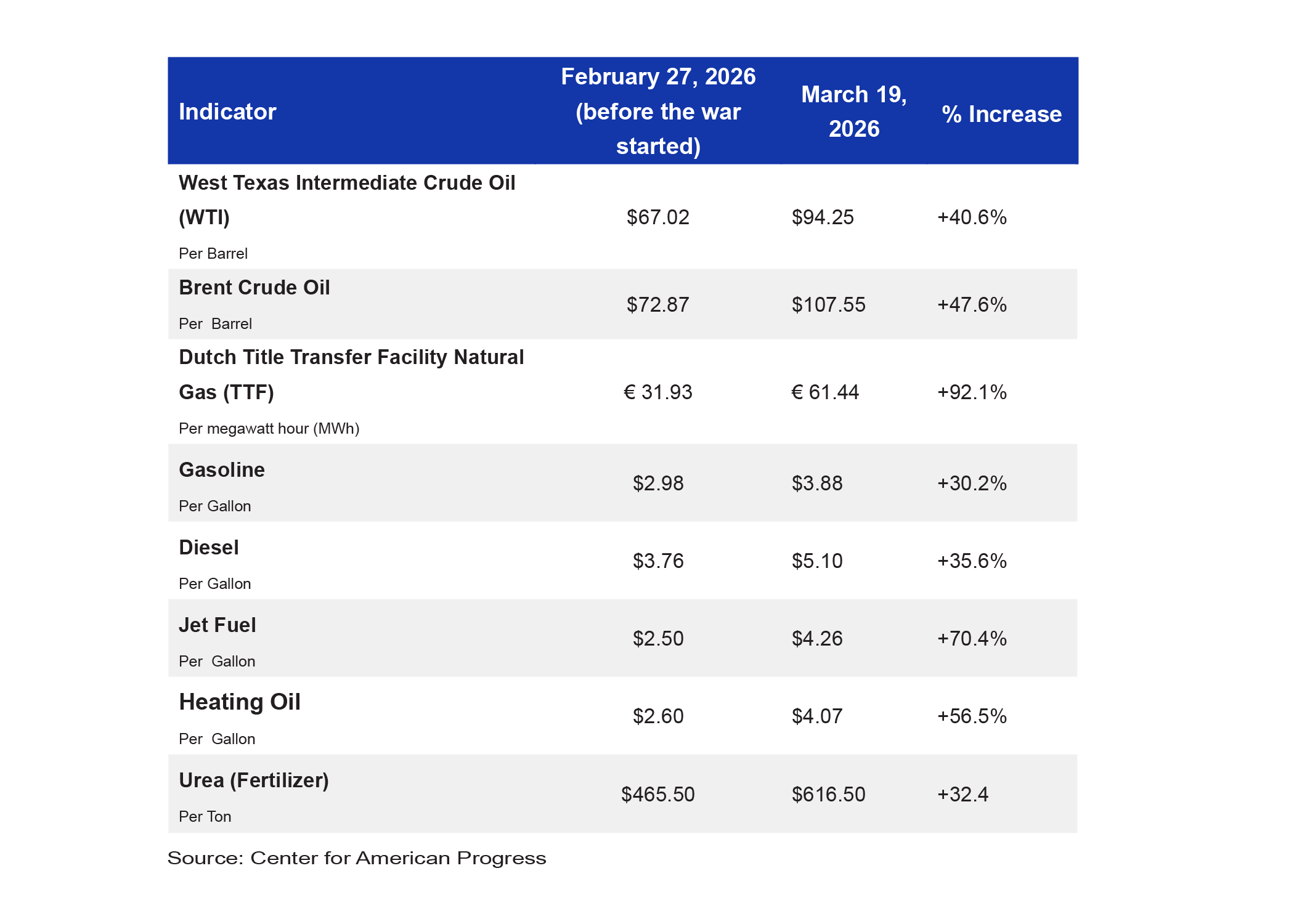
Since the conflict began, fertilizer markets have tightened considerably, with prices rising sharply across multiple product categories. According to World Bank commodity market data, fertilizer prices have seen double-digit percentage increases during recent energy and supply shocks, with volatility amplifying during geopolitical disruptions. For U.S. farmers, that is a significant hit, particularly given the timing as planting decisions are being made.
Fertilizer is one of the largest line items in crop production, especially for corn, based on USDA cost-of-production data. As prices rise, farmers are forced to adjust. Some are shifting acreage toward crops like soybeans that require less nitrogen, while others are reducing application rates, decisions that can ultimately constrain supply or reduce yields.
Energy Costs Working in the Background
At the same time, energy prices are moving higher. Oil pricing, which is now hovering in the range of $100 per barrel, has a ripple effect that extends well beyond the fuel pump.
On the farm, higher diesel prices increase the cost of running equipment, irrigating fields, and moving crops. Beyond the farm, transportation costs rise across the board. The American Transportation Research Institute (ATRI) has long identified fuel as one of the largest drivers of freight costs in trucking, a dynamic that becomes more pronounced during oil price shocks. A distributor pays more to move goods, a processor pays more to produce them, and retailers eventually adjust pricing to maintain margins. This cost buildup tends to move gradually but persistently through the system.
Delays, Gaps, and a More Fragile Supply Chain
Beyond cost, reliability is becoming an issue. Shipping delays are increasing, and delivery times are less predictable, according to various maritime trade updates. Disruptions in key global shipping corridors tend to amplify volatility in both transit times and freight pricing, especially when rerouting becomes necessary.
Perishable goods are the first to be affected. Delays can quickly tighten supply and push prices higher. At the same time, companies are carrying more inventory as a buffer, tying up capital and adding financial pressure in an already low-margin business.
How This Shows Up in Grocery Prices
The impact on grocery prices is building, though not uniformly, across categories. Perishable items like produce are among the first to reflect higher transportation and logistics costs. Fertilizer prices are feeding into grain markets, affecting products such as bread, cereals, and processed foods. Meat and dairy prices are also influenced through higher feed costs, a relationship consistently tracked by the USDA and FAO in food price transmission studies. These effects tend to take longer to fully materialize, but once in place, they’re often persistent.
Farmers Are Caught in the Middle
For U.S. farmers, the current environment is particularly difficult. Many were already dealing with tight margins coming out of 2025, shaped by higher interest rates, prior tariff pressures, and uneven weather conditions. The USDA and Federal Reserve have both highlighted the rising financial stress across the agricultural sector in recent reports.
Now, input costs are rising again, and farmers have limited ability to respond. Crop prices are set in global markets and do not always keep pace with rising costs. That leaves farmers adjusting planting decisions, reducing input usage, or delaying capital spending, each with trade-offs that can affect both short-term performance and longer-term productivity.
A Mixed Picture for the Rest of the Supply Chain
The effects of the conflict vary across the agricultural ecosystem. Fertilizer producers may benefit from higher prices but face their own, unique cost and logistical pressures. Equipment demand may soften as farmers pull back on spending. And while distributors are balancing higher inventory costs with uncertain demand, food processors and retailers face margin pressure as input costs rise faster than pricing can adjust.
What Lenders Should Be Watching
For lenders, this is an environment where small changes can signal larger problems. Margins are tightening across agricultural producers, food companies, and grocery retailers, all of which typically operate on thin margins. At the same time, rising input costs are increasing working capital needs and placing additional strain on liquidity.
Collateral values are also becoming more volatile. We have seen that inventory and commodity-linked assets can fluctuate more quickly in periods of price instability, particularly when driven by global energy and agricultural shocks. Adding to this, discussions we are having with industry contacts suggest there are also signs that some farmers are delaying equipment purchases to preserve liquidity. This could have a ripple effect across equipment financing portfolios and dealer networks.
Suggested Lender Monitoring
For asset-based lenders, evaluating borrowers now requires attention to margin, profitability, and collateral liquidity. Hilco recommends a lender to monitor:
- Margins and Profitability: Farm industry margins are generally thin and volatile. The food industry sector profit margins as a whole are generally thin and highly competitive. Impacts from tariffs and now higher inputs from the Iran conflict (particularly fertilizer, fuel, and freight costs) will further pressure margins and profitability. Lenders should monitor these regularly.
- Impact on Industries Servicing Farm Industry: While input prices are high, some agricultural inputs and equipment suppliers may see mixed demand. Rising operating costs are making farmers more cautious about capital expenditures on new machinery. Lenders should monitor sales, inventory levels, margins, and profitability.
Closing Thoughts
The 2026 Iran conflict is still evolving, but its impact on the U.S. food system is already becoming clear. It’s a combination of higher input costs, logistical friction, and constrained supply moving through the system in stages. For consumers, that likely means higher grocery bills over time. For farmers, it means another year of difficult trade-offs and tighter margins. And for lenders and investors, it means limiting risk by being hyper diligent about the details, staying closely connected to borrowers, well informed about the specific challenges they’re facing and how those challenges are being addressed.
*We encourage lenders with portfolio exposure in agriculture commodities, food products, and other related business along these supply chains, to contact our Hilco Valuation experts for answers to any questions you may have about current challenges/developments facing those businesses. Hilco Global, through its overall deal count volume and diversified platform of financial services, conducts thousands of hours of senior executive conversations each month with borrowers. These management conversations provide a wealth of knowledge with up-to-the-minute insights on the constantly changing market environment, which Hilco is then able to pass along to its clients. We are here to help our lending clients and borrowers leverage Hilco’s collective knowledge base to make well-informed, critical and informed lending decisions.