The California Wine Industry is Under Structural Pressure in 2026

June 2026
California produces roughly 81% of all U.S. wine and remains the world’s fourth-largest wine region, supported by about 4,700 bonded wineries. Despite this scale, the industry is operating under sustained pressure across nearly every dimension of the market, including consumption, bulk wine pricing, vineyard utilization, and distribution access. The common thread is a persistent oversupply condition that has weighed on pricing, forced vineyard removals or idling, and reduced overall economic efficiency across the sector.
This imbalance is primarily demand-driven. Wine consumption has been gradually declining under pressure from multiple substitutes, including spirits, ready-to-drink beverages, hemp-based products, and non-alcoholic alternatives. These shifts are especially pronounced among younger consumers, who tend to spread their preferences across a broader set of beverage categories. As demand has softened, distribution has also tightened, with many wineries reporting reduced shelf space and fewer on-premise listings, further limiting throughput and reinforcing inventory buildup.
Export Weakness and Trade Friction
Export markets, once a stabilizing outlet for excess production, have also deteriorated. The most significant disruption has come from Canada, where provincial restrictions on U.S. alcohol contributed to an estimated 77% decline in 2025 sales, representing more than $350 million in lost revenue for U.S. producers. Even where restrictions have been partially eased, recovery has been limited, with exports remaining sharply lower on a year-over-year basis throughout 2025.

Beyond Canada, California wine has faced growing resistance in several traditional export destinations, including parts of Europe and Japan. Tariff pressure, retaliatory trade measures, and shifting import preferences have reduced pricing competitiveness and weakened demand visibility. At the same time, broader U.S. trade policy friction has made bulk wine less predictable in global markets, reinforcing a structural oversupply condition at home.
Geopolitical Cost Pressures and Supply Chain Disruption
Overlaying these demand challenges is a meaningful increase in global cost pressure tied to geopolitical instability, particularly disruption in and around the Strait of Hormuz. The resulting volatility in energy markets has pushed oil and diesel prices higher, while also increasing container freight rates, inland transportation costs, and war-risk insurance premiums. For bulk wine, an inherently low-margin and high-volume export product, these increases have a direct and often immediate impact on profitability.
Just as importantly, logistics reliability has deteriorated. Shipping delays and port congestion have become more frequent across key export corridors into Asia and Europe, creating uncertainty around timing, fulfillment, and contract execution. At a time when buyers are already more selective, this combination of higher cost and lower reliability is weakening contract stability and adding friction to international sales execution.
Production, Inventory, and Market Imbalance
Despite weakening demand, production has only partially adjusted. The 2025 California wine crush totaled 2.62 million tons, down 8.5% from 2024. White wine grapes accounted for 1.32 million tons, while red wine grapes totaled 1.31 million tons, down 10.8% year over year. While this represents a meaningful contraction from prior peaks, it has not been sufficient to correct the broader oversupply condition that has built up over multiple vintages.
Inventory levels reflect that imbalance. As of March 2026, approximately 29.2 million gallons of bulk wine were actively available for sale statewide, near record levels despite recent production declines. For context, inventory levels were approximately 24 million gallons in February 2024 and 24.8 million gallons in June 2025. Although some reduction is expected as older vintages age out or are repositioned, the bulk market remains structurally heavy.
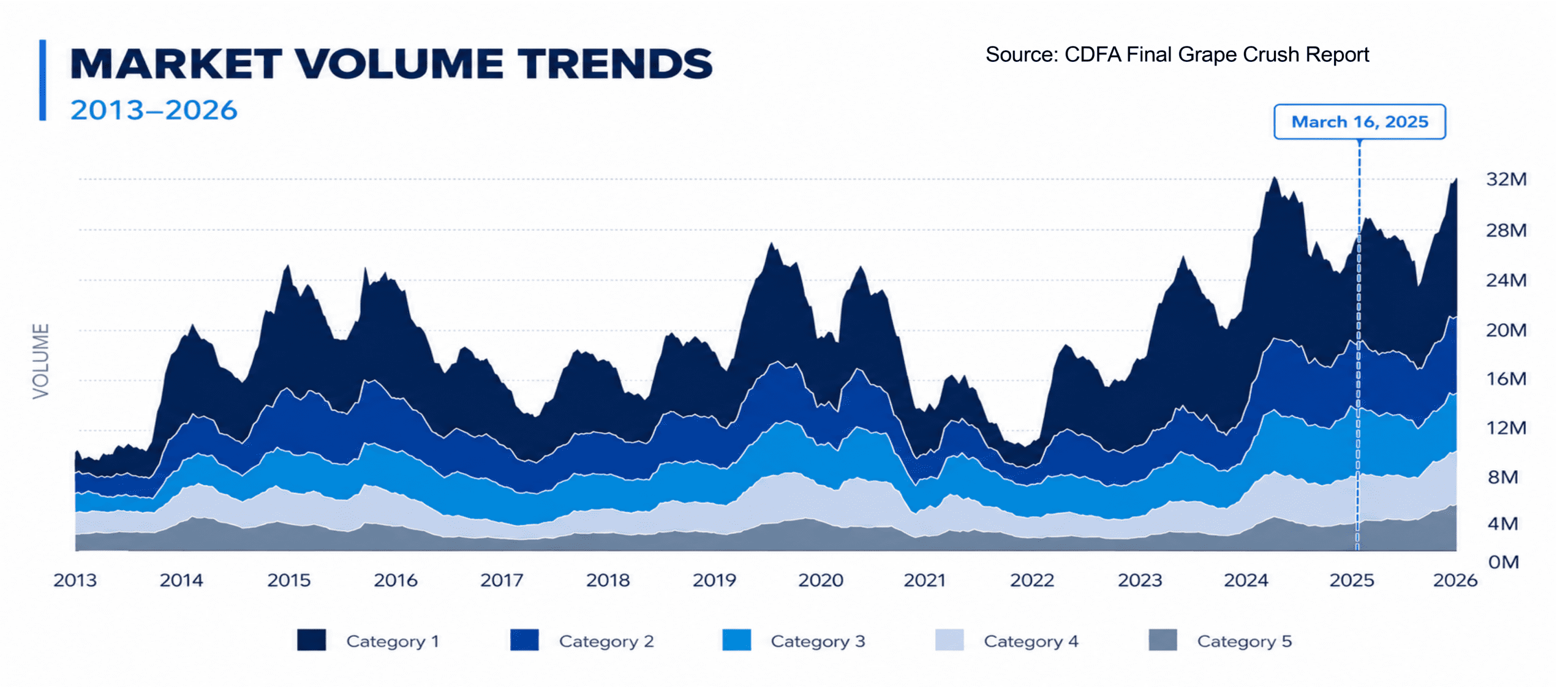
Bulk wine itself spans a wide spectrum, from wine still aging in barrel or tank to fully finished wine awaiting bottling. That variability contributes to pricing dispersion and makes valuation more sensitive to timing, quality, and market conditions than in more standardized commodity markets.
Lender Guidance
Looking forward, it is difficult to anticipate the direction of the California wine market, however a continued decline is likely to persist. Although continued decline is anticipated, many believe that the worst is in the past and any future decline will be minimal. Still, lenders should anticipate that these lower production and sales levels will be the new normal, as a return to previous levels is not likely in the near future.
Lenders should be aware of the ongoing bulk market decline and understand that liquidations in this space may take longer than anticipated and may not yield the same returns as they might have even one year ago. In addition, they should monitor inventory levels of cased wine and gross margins, as excess cased wine may prompt discounting, leading to a decline in gross margin. They should also watch for other warning signs such as negative cash flow despite revenue growth, deteriorating vineyard yields, and loss of key distribution relationships.
Additionally, it is important to be properly informed regarding the other unique risks and dynamics of this highly seasonal, capital-intensive, and fragmented industry. The long production cycle, aging inventory, and dependence on agricultural conditions each create complex borrowing base management challenges. Risks such as wildfires, droughts, labor shortages, shifting consumer preferences, and market oversupply can also work to quickly undermine a borrower’s viability.
Shifting consumer preferences pose a particularly serious long-term threat. Baby Boomers, who have long been the core consumers of wine, are aging out of the market, and younger generations—particularly those in their 20s through 40s—have not shown the same level of enthusiasm for wine consumption. Many younger consumers are gravitating toward craft spirits, ready-to-drink cocktails, low- and no-alcohol beverages, or health-conscious alternatives. If this generational shift continues without a corresponding uptick in wine adoption among Millennials and Gen Z, the industry could face a prolonged demand contraction, especially in the mid-tier and premium wine segments. Lenders should factor this into their risk assessments, particularly when evaluating borrowers heavily invested in traditional distribution channels or large-scale production.
To protect their interests, ABLs should plan to conduct frequent inventory appraisals that account for aging wine and market conditions, recalibrate borrowing bases dynamically, and implement strong covenants tied to liquidity, inventory turns, and sales trends. Ongoing field exams, detailed reporting requirements, and proactive borrower engagement can help lenders spot trouble early and work collaboratively with borrowers to right-size operations, improve cash flow, and shift toward higher-margin channels like direct-to-consumer when appropriate. In high-risk areas, lenders should also consider steps such as securing liens on vineyards, trademarks, and customer lists. With this in mind, we encourage you to reach out to our highly experienced team today to discuss current challenges with your business or a business in your portfolio.
About Hilco Global Valuations
Hilco Global is the world’s leading provider of asset appraisals with a proven, decades-long track record of providing the most accurate appraisals across all asset categories. The scope of the valuations we deliver range from a single asset in one domestic location to millions of assets located around the world.
We are able to affirm current asset value through proprietary market data sourced from the collective worldwide asset disposition and acquisition experiences of Hilco Global over time. In contrast to the aged data relied upon by others in the industry, access to this cumulative, real-time information ensures delivery of the most reliable valuations for our clients.
As one of the world’s largest and most diversified business asset appraisers, field examiners and valuation advisors, we have expertise across a wide range of asset classes including inventory, machinery and equipment, real estate, and enterprise valuation. From aerospace and financial services to retail and energy, healthcare, and technology, we have delivered valuations for all industries. Additionally, the breadth and depth of our expertise enables us to provide services ranging from Lending and Financial Reporting to Enterprise Planning and Litigation Support.
*The views and opinions expressed are provided for general informational and educational purposes only and are subject to change without notice. This publication does not constitute investment, tax, or legal advice, nor should it be relied upon as a recommendation regarding any course of action. The information contained herein is provided “as is” without any representations or warranties as to its accuracy, adequacy, or completeness. While Hilco Trading, LLC has exercised reasonable care in preparing this publication, it assumes no liability for any actions taken or not taken based on its contents. Past performance is not indicative of future results.