The Cup is Half Empty

August 2026
At 16.5 million vehicles, the seasonally adjusted annual rate of sales (SAAR) for June was the highest recorded thus far in 2026 and roughly 2.0 million vehicles above the rate at the start of the year, when sales during the final two weeks of January were depressed by unusually severe weather. The SAAR never fell below 16.0 million vehicles during the second quarter and averaged nearly 1.0 million vehicles more than in the first quarter. Despite this generally positive sales trend, most industry analysts have not changed their outlook. The consensus forecast for 2026 U.S. light-duty vehicle sales remains between 15.8 million and 16.0 million units, a decline of 2% to 3% from 16.3 million in 2025.
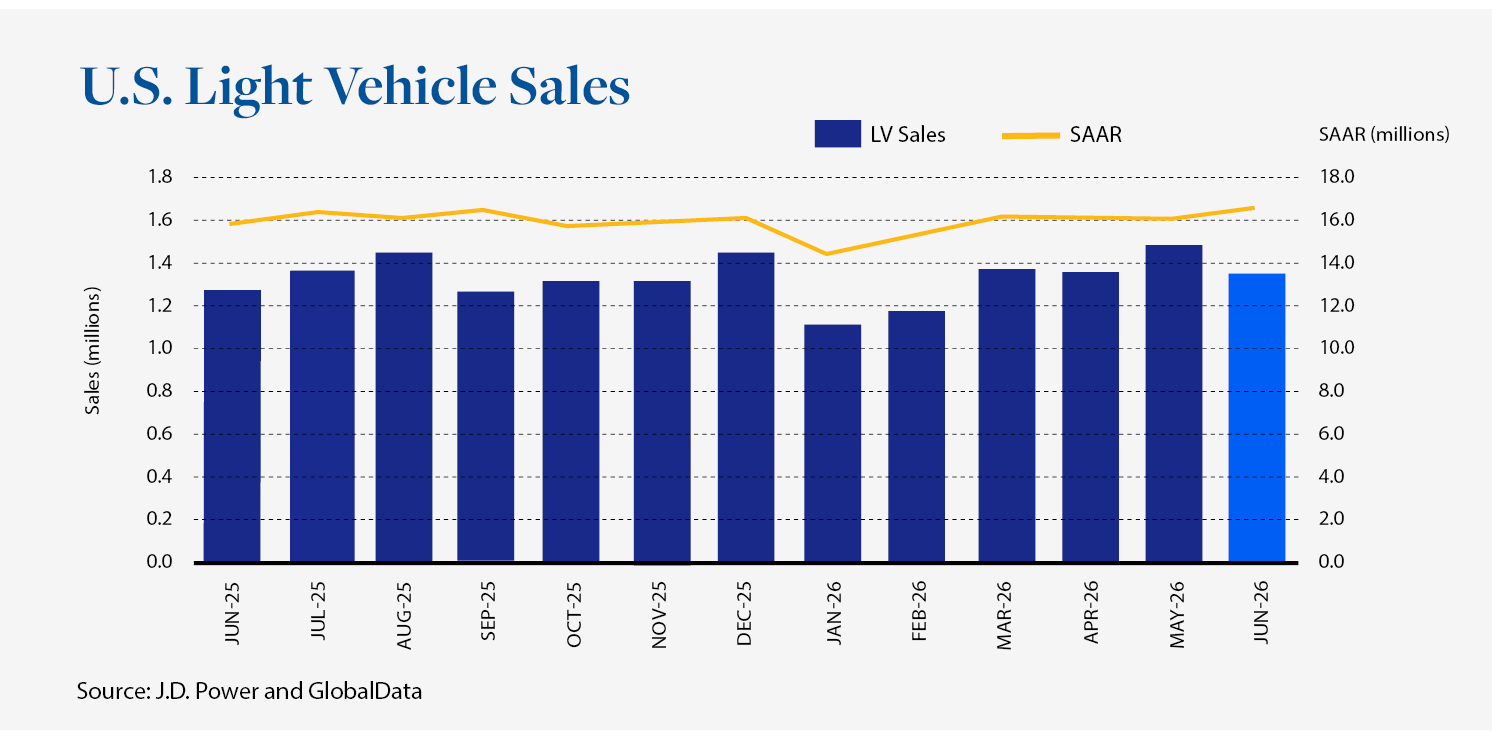
The consensus among industry analysts has changed little since the first quarter—and why should it? Consider financing costs. The average annual percentage rate (APR) on a new-car loan was 7.0% at the end of the second quarter, down 20 basis points from a year earlier but up 10 basis points from the first quarter. Is that good news or bad news? The average price of gasoline was $3.88 per gallon at the end of June, down $0.12 from the prior month but up $0.74 from a year earlier. Again, is that good news or bad news? The same ambiguity applies to inventory and sales incentives. In the absence of clearly bad news, analysts could favor the upside scenario; in the absence of clearly good news, they could just as easily favor the downside. Put another way, is the cup half full or half empty? Most industry analysts currently view it as half empty, with consumer affordability weighing most heavily on their outlook.
The average manufacturer’s suggested retail price (MSRP) of a new vehicle is now above $50,000, while the number of models with a list price below $30,000 continues to decline. Based on the current product mix, nearly twice as many new vehicles are available with an MSRP above $100,000 as with an MSRP below $30,000. It is therefore unsurprising that fewer than 7.5% of all vehicles sold had an MSRP below $30,000. At the same time, dealers reported that nearly one-third of first-quarter trade-ins carried negative equity, meaning the borrower owed more than the vehicle was worth.
Under these circumstances, consumers are reducing their down payments, extending their loan terms, or doing both to finance a new vehicle. The average down payment on a new-vehicle purchase was $5,815 in the second quarter—only slightly more than 10% of the average purchase price and the lowest share since 2020. Despite consumers’ efforts, the average monthly payment continues to rise, setting a record each quarter. Nearly one in five new-car borrowers now pays at least $1,000 per month, and nearly one in four chooses a loan term of 84 months (seven years) or longer. The average monthly payment for a new vehicle was $777 last quarter, and the average term was 70.4 months.
Are longer-term auto loans and four-figure monthly payments creating the next housing bubble? Probably not. As with the housing bubble, however, one consequence of loose credit practices in the lending community has been an increase in negative equity. Although Americans owe a record $1.7 trillion in auto-loan debt, that amount represents less than 10% of total consumer debt. By contrast, housing debt represented roughly 70% of U.S. consumer debt when the housing bubble burst, which helps explain its devastating economic impact. Even if stress in the auto-lending market intensifies, it is unlikely by itself to cause a recession—but there would still be consequences. If consumers lengthen their replacement cycles, keeping vehicles for four years instead of three, what would that mean for annual sales volume? Questions such as these are prompting dealers and manufacturers to pause.
The good news is that the new-vehicle market faced a similar crossroads at this time last year, and the second half ultimately performed much better than expected. In the first quarter of 2025, consumers rushed to dealerships to buy vehicles ahead of rising tariffs, but sales velocity slowed considerably in the second quarter. At the time, the scheduled expiration of government subsidies for electric vehicles was expected to weigh on sales, and dealers and manufacturers anticipated a weaker second half. Instead, third-quarter sales were buoyed by purchases of electric vehicles that were about to lose favorable tax treatment, and that momentum carried into the fourth quarter. Rather than posting the modest decline many had anticipated, full-year 2025 sales increased 2.2% from the prior year.

*The views and opinions expressed are provided for general informational and educational purposes only and are subject to change without notice. This publication does not constitute investment, tax, or legal advice, nor should it be relied upon as a recommendation regarding any course of action. The information contained herein is provided “as is” without any representations or warranties as to its accuracy, adequacy, or completeness. While Hilco Trading, LLC has exercised reasonable care in preparing this publication, it assumes no liability for any actions taken or not taken based on its contents. Past performance is not indicative of future results.