The Data Center Development Gap

June 2026
Over the last three years, hyperscalers and infrastructure developers have raced to keep up with exponentially increasing global demand for compute power. Leading AI companies are well on their way to deploying an estimated $1.7 trillion on data center expansions between 2024 and 2030 in one of the most aggressive infrastructure build cycles in modern industrial history.1 AI workloads, hyperscaler cloud augmentation, national security compute priorities, and enterprise digital transformation have molded the sector into the most capital-intensive growth market in the world. However, the sector is increasingly encountering constraints that limit hyperscalers’ ability to meet forecasted demand—thus, a data center development gap.
Across the United States, developers are facing increasing delays tied to interconnection queues, unstable supply chains, and growing public opposition to planned data centers. Projects underwritten on optimistic input assumptions are, in many cases, seeing operational delays ranging from quarters to years to outright cancellations. According to Bloomberg, of the 12 gigawatts (GW) of data center capacity set to come online in 2026, only 5 GW are under active construction.3 This trend extends to 2027, as a mere 6.3 GW of the 21.5 GW of announced capacity has broken ground.
These factors represent a broad phase of market reconciliation in which infrastructure development must align with the practical limitations of the domestic grid, supply chains, political institutions, and community tolerance.
The Interconnection Bottleneck
The most significant impediment to data center expansion is reliable access to electricity, as hyperscaler AI deployment has fundamentally changed the magnitude of power consumption demanded by compute facilities. New data center campuses are routinely structured to supply several hundred megawatts (MW) of compute capacity, a massive increase from output figures associated with pre-AI developments. The largest
U.S. projects, such as OpenAI’s Stargate campuses in Texas and Michigan, will each exceed 1 GW of compute capacity once fully operational.4 As the geographic footprint and compute capacity of data centers continue to grow, so do interconnection requests. The Lawrence Berkeley National Laboratory’s Energy Markets & Policy group reported that as of the end of 2025, over 2,060 GW of total generation and storage capacity were seeking connection to the grid.5 The United States has about 1,250 GW of utility-scale electricity generation capacity, meaning that current interconnection requests equal 165% of available capacity.6
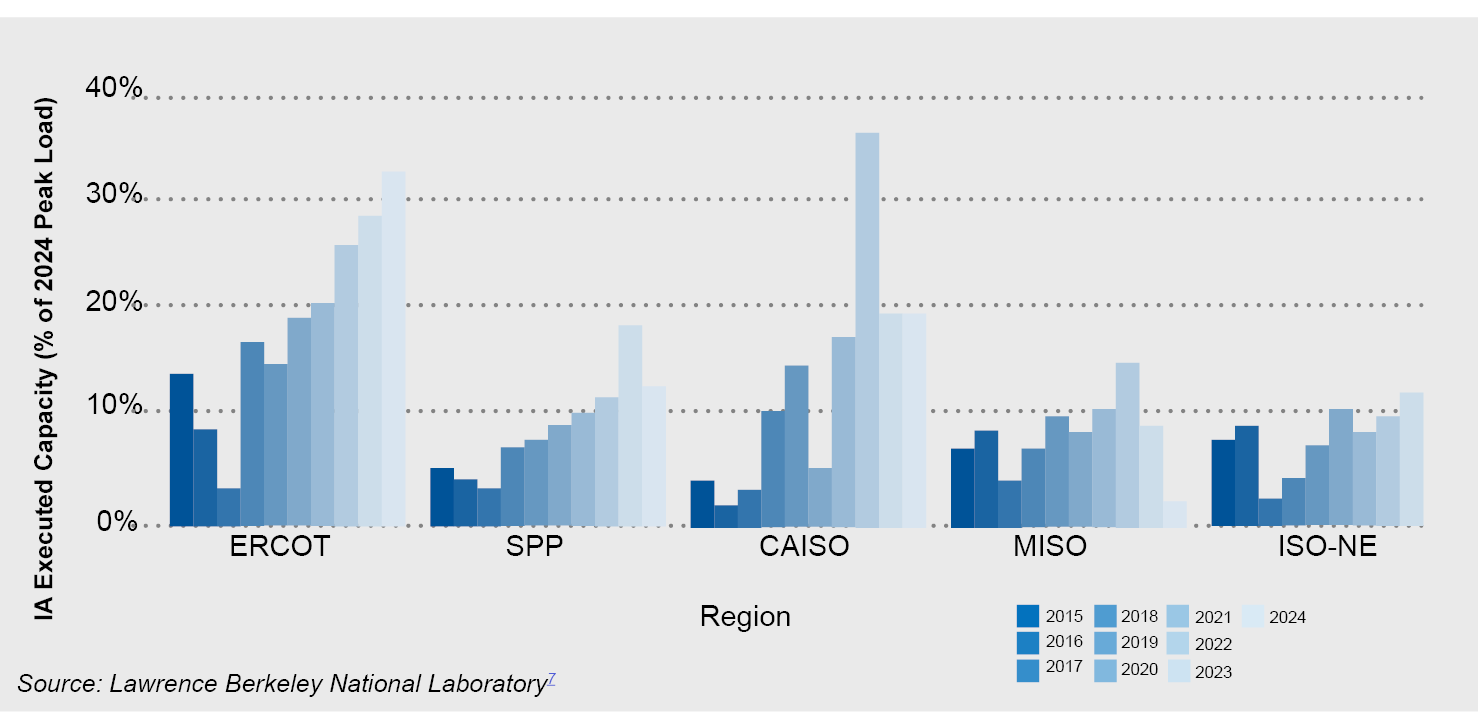
Developers across Northern Virginia, Arizona, Texas, Georgia, and Ohio increasingly face multi-year timelines to secure reliable power delivery commitments. In many cases, utility providers are requiring extensive substation upgrades, transmission expansion, or entirely new generation capacity before projects can proceed. Initial utility interconnection now takes 5-7 years, and new transmission upgrades take 5-10 years or more.8, 9 Comparatively, data center construction timelines, from groundbreaking to operational readiness, typically take anywhere from 18-36 months for standard hyperscaler data centers to 36-60 months for AI mega-campuses.10 Without preexisting interconnection agreements, developers can build data centers faster than power can be delivered to them.
Supply Chains Under Strain
Even operators with secured utility agreements face delays tied to supply chain disruption. The breakneck pace of the global data center market has led to demand surges for transformers, switchgear, generators, cooling systems, and high-voltage electrical equipment, with procurement timelines stretching from months to years as global demand outpaces manufacturing capacity.
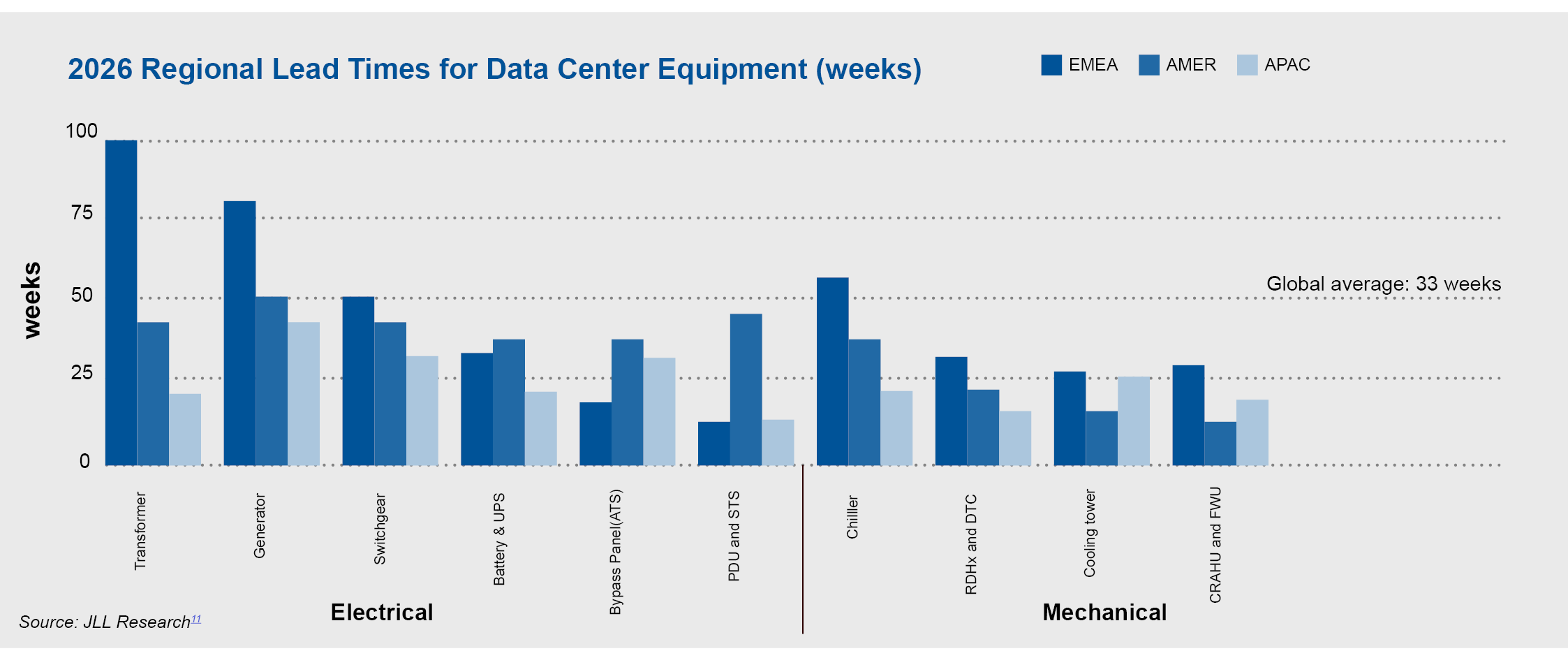
Transformers, which convert high-voltage grid electricity into lower-voltage, usable energy, are the strongest case study to observe this trend. Given the electrical demands of modern AI data centers, multiple utility-scale power transformers are required on each site, resulting in a demand spike of 116% and a cost increase per unit of 77% since 2019.12 Transformer manufacturing is geographically concentrated across a handful of countries, including China, Mexico, South Korea, and Japan. The United States imports 80% of power transformers, 50% of distribution transformers, and a substantial number of key components and essential commodities from overseas manufacturers.13 Gas turbines, increasingly essential as developers pivot to behind-the-meter generation in order to bypass interconnection queues, have become another pressure point. According to Wood Mackenzie, global gas turbine orders reached 110 GW at the end of 2025 against a global manufacturing capacity of only 60-70 GW, pushing prices up an estimated 195% since 2019 and stretching lead times to roughly six years.14 Sweeping U.S. tariffs and geopolitical “de-risking” efforts have further increased costs across global electrical equipment markets, with neither reindustrialization nor procurement diversification addressing the near-term supply crunch.
The Politics of Compute Expansion
Alongside infrastructure constraints, developers are now confronting a growing political and social movement to impose moratoriums across emerging and developed data center markets.
Historically, data centers were viewed favorably by state and local governments for the tax revenue and economic development they promised. Loudoun County, Virginia, is one of the strongest examples of how data centers can transform communities. Nicknamed “Data Center Alley,” Loudoun County’s permissive position towards data center development includes favorable zoning and guidelines, sales and use tax exemptions, and public/private partnerships to upgrade local grid connectivity. The implementation of these policies, starting in 2010 when Virginia enacted its landmark data center sales-and-use tax exemption program, has directly led to a windfall in tax revenue reflected by Loudoun County’s annual budget, which has increased from about $1.7 billion in 2010 to over $5.4 billion in 2027.15, 16 In Loudoun County’s FY2027 budget, data centers alone account for nearly $1.3 billion, or roughly 45% of tax revenue.17
Recently, the favorable policy positions that once enabled aggressive build cycles have begun to reverse, as a growing number of jurisdictions consider measures to restrict new developments. Since the start of the 2025-2026 session, twelve state legislatures have proposed some form of statewide moratorium on data centers.18 Maine’s legislature was the first to pass a statewide moratorium, pausing the development of data centers exceeding 20 MW of capacity until late 2027, but the measure was subsequently vetoed by Governor Janet Mills.19 Separately, several governors and state legislatures have proposed altering existing tax exemptions and subsidy policies for data centers, including Virginia, Illinois, and Georgia. Though most proposals have not advanced, Washington became the first state to roll back certain data center tax exemptions. On April 1, 2026, Washington State Governor Bob Ferguson signed Senate Bill 6231 into law, cutting a sales tax exemption for data center operators replacing or refurbishing old server equipment.20
Compounding this shift is growing scrutiny of the employment benefits associated with data centers. While developers and trade associations have long touted new projects as engines for job creation, many of the employment opportunities have come in the form of temporary construction roles and then are reduced once a facility goes online. A 2024 study by the Virginia Joint Legislative Audit and Review Commission found that a typical 250,000-square-foot data center supports approximately 50 full-time workers, roughly half of whom are contract employees.21
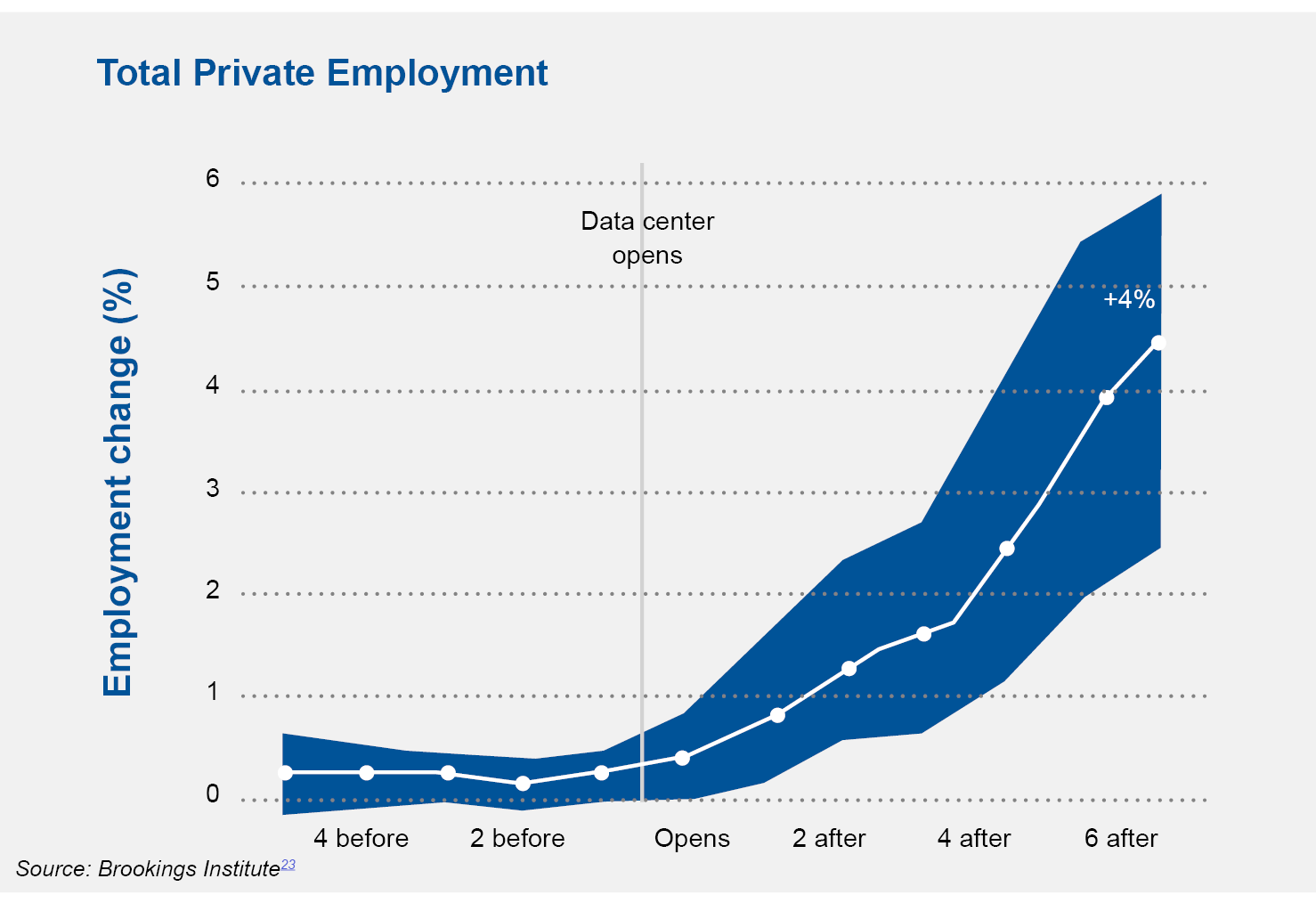
The Brookings Institution recently published an analysis of 770 U.S. data center facilities, which found that while data centers do produce measurable local employment gains, industry-sponsored estimates overstate the effect by roughly a factor of three when they fail to account for pre-existing county growth trends. 22 The asymmetry between tax incentives afforded to data center operators and permanent job creation has become a central point in debates sweeping statehouses and dinner tables alike.
These trends add uncertainty to development underwriting. As the industry expands into secondary and tertiary markets, state and local political engagement will increasingly become a strategic advantage for operators who win community support before development.
The New Underwriting Reality
The thesis that underwrote development from 2021 to 2024 needs revisiting. Previously, many developers assumed that aggressive financing, tax-friendly jurisdictions, and premium land acquisition could streamline operational hurdles.
Today, that thesis leads to overallocation of capital and opens investors to risks associated with interconnectivity queues, disgruntled communities, extended lead times, and even outright project cancellations. A developer cannot outbid competitors for grid capacity if transmission infrastructure does not physically exist, and capital cannot accelerate transformer manufacturing or override community opposition.
The variables for success that once defined the data center market are rapidly changing how projects must be underwritten. To minimize project risk, factors impacting deliverability, including interconnection status, utility relationships, entitlement certainty, procurement timelines, and community engagement, should be considered paramount.
The Winners
- Brownfield Operators: New campuses built on previously energized industrial sites often possess existing utility infrastructure, transmission access, and permitting histories that materially reduce development With new interconnection capacity increasingly difficult to secure, already-connected infrastructure carries a significant premium.
- Leading Hyperscalers: Hyperscalers like Meta, Oracle, Microsoft, Google, and Amazon Web Services enter every utility negotiation with advantages that smaller developers cannot replicate. Their balance sheet strength, long-term planning horizons, and utility relationships allow direct coordination with grid operators, making preferential access to grid capacity typically within
- Flexible States, Counties, and Communities: Jurisdictions with predictable permitting and viable grid access are positioned to attract disproportionate investment as operators exit more restrictive markets.
The Losers
- Speed-to-Market Projects: Projects underwritten around outdated market assumptions may experience deteriorating returns as energization timelines extend and carrying costs accumulate.
- Volatile Geographies: Markets with rising political opposition, community pushback, or uncertain regulatory frameworks will become less attractive destinations for new developments.
- Capacity Miscalculations: Firms that overestimate deliverable capacity by underestimating grid constraints and procurement timelines stand to threaten returns due to project delays or outright cancellations.
Market Outlook
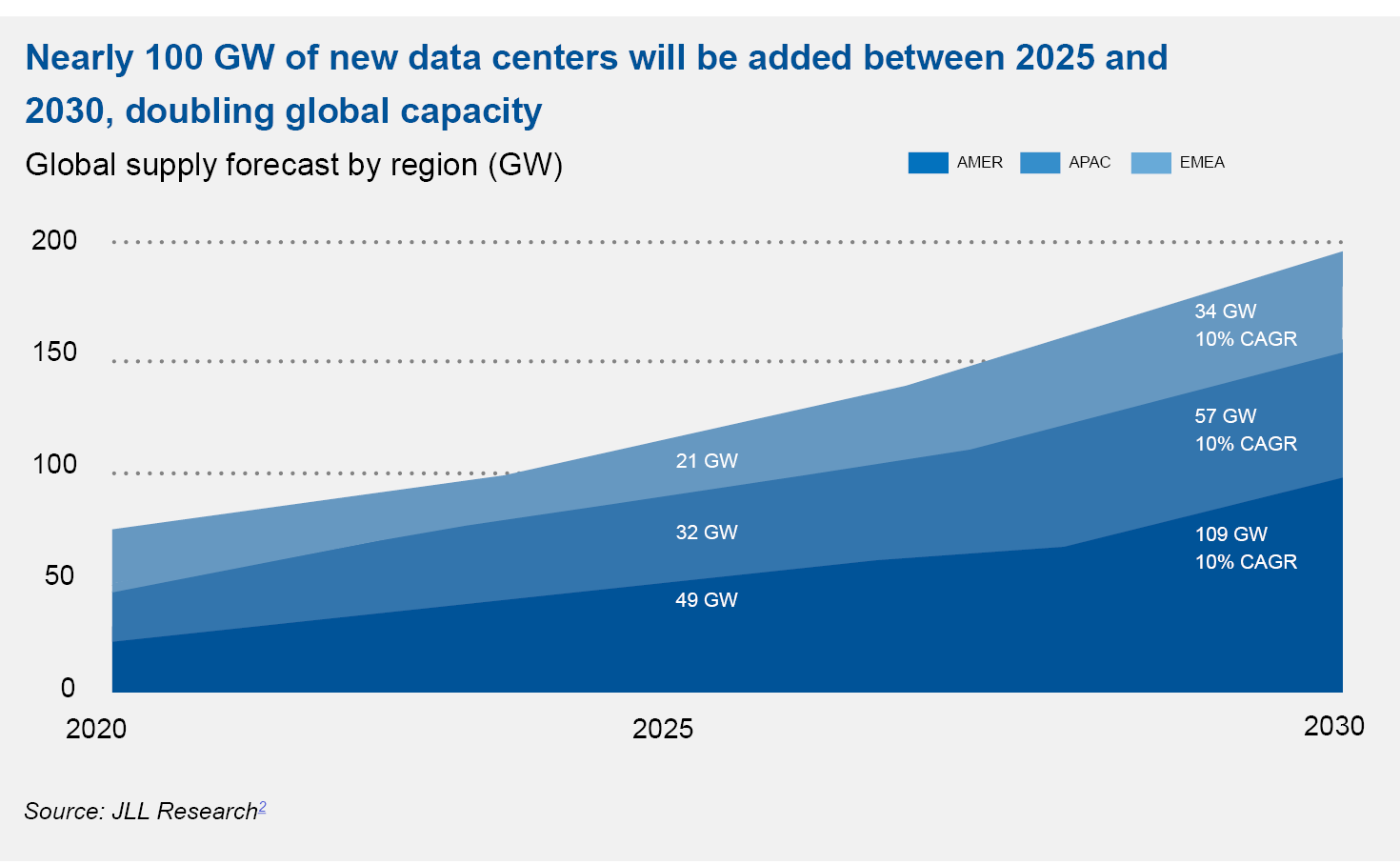
As domestic constraints intensify, developers and hyperscalers are looking to cross-border solutions to diversify capital allocation to international markets. JLL’s 2026 Global Data Center Outlook forecasts EMEA capacity to grow at a 10% CAGR through 2030, adding 13 GW of new supply, while Asia-Pacific is expected to expand from 32 GW to 57 GW over the same period.24 Google announced a $15 billion investment in Indian AI infrastructure as part of the America-India Connect initiative, alongside new regional launches in Sweden, South Africa, and Mexico. [25-28] Markets across the Gulf, Southeast Asia, and Latin America offer comparatively faster permitting, sovereign capital support, and grid environments less saturated by AI-driven demand. For investors with the appetite and infrastructure to operate across jurisdictions, international markets represent a viable hedge against U.S. deliverability risk.
With utility interconnection timelines stretching to 5-7 years across most major markets, hyperscalers and developers are increasingly pursuing on-site power generation to bypass the grid altogether. Enverus is tracking more than 40 GW of announced behind-the-meter and co-located generation capacity across the United States, with natural gas accounting for over 10 GW of total announced capacity.29 Oilfield services companies, including Liberty Energy, VoltaGrid, and Solaris, have emerged as a new supply source, leveraging existing turbine relationships and distributed generation expertise. [30-32] The viability of this trend rests on the immediate availability of generation capacity and the regulatory flexibility of states like Texas that permit large loads to operate on dedicated generation.
Nuclear energy has reentered mainstream conversation as hyperscalers and operators look for alternative methods to source power. Small modular reactors (SMRs) are advanced nuclear reactors that generate up to 300 MW per unit, roughly one-third the capacity of a traditional reactor, and are designed to be factory-built and shipped to site, enabling faster deployment and incremental scaling.33 Announced commitments between 2024 and 2026 collectively exceed 10 GW of contracted SMR capacity.34 Amazon’s partnership with X-energy targeting 960 MW in Washington state and Google’s Master Plant Development Agreement with Kairos Power for up to 500 MW both represent landmarks in the early adoption of data center-optimized nuclear power.35, 36 The limiting factor is timing, as the earliest commercial SMR deployments serving data centers are not expected before 2030. For investors, the immediate opportunity exists in positioning around the SMR supply chain, advanced nuclear developers, and sites with existing nuclear interconnections—a scarce form of long-duration power certainty that will command premium valuations.
Sources:
- Dell’Oro Group
- JLL Research
- Sightline Climate
- OpenAI
- Berkeley Lab, Energy Markets and Planning
- S. Energy Information Administration
- Lawrence Berkeley National Laboratory
- POWER Magazine
- Bessemer Venture Partners
- POWER Magazine
- JLL Research
- Wood Mackenzie
- Wood Mackenzie
- Wood Mackenzie
- Virginia Tax
- Loudoun County, Virginia
- / City Journal
- ChargedUp!
- Portland Press Herald
- Ballard Spahr
- Joint Legislative Audit and Review Commission of Virginia
- Brookings Institute
- Brookings Institute
- JLL Research
- Google India
- Google Sweden
- Google South Africa
- Google Mexico
- Enverus
- POWER Magazine
- Argus
- Fortune
- Yale Energy Forum
- Yale Energy Forum
- Utility Dive
- Kairos Power
*The views and opinions expressed are provided for general informational and educational purposes only and are subject to change without notice. This publication does not constitute investment, tax, or legal advice, nor should it be relied upon as a recommendation regarding any course of action. The information contained herein is provided “as is” without any representations or warranties as to its accuracy, adequacy, or completeness. While Hilco Trading, LLC has exercised reasonable care in preparing this publication, it assumes no liability for any actions taken or not taken based on its contents. Past performance is not indicative of future results.