
The Industry Anticipates a Slow Second Half

July 2025
The second quarter began much the way the first quarter ended with sales running ahead of forecasts as consumers were eager to buy new vehicles before tariffs took effect. The seasonally adjusted annualized rate (SAAR) of sales for April was 17.3 million vehicles, the second month in a row that U.S. light vehicle sales exceeded 17 million vehicles. The market has flirted with a SAAR of 17 million vehicles from time to time, but this is the first time in four years that monthly sales exceeded a SAAR of 17 million vehicles for two consecutive months.
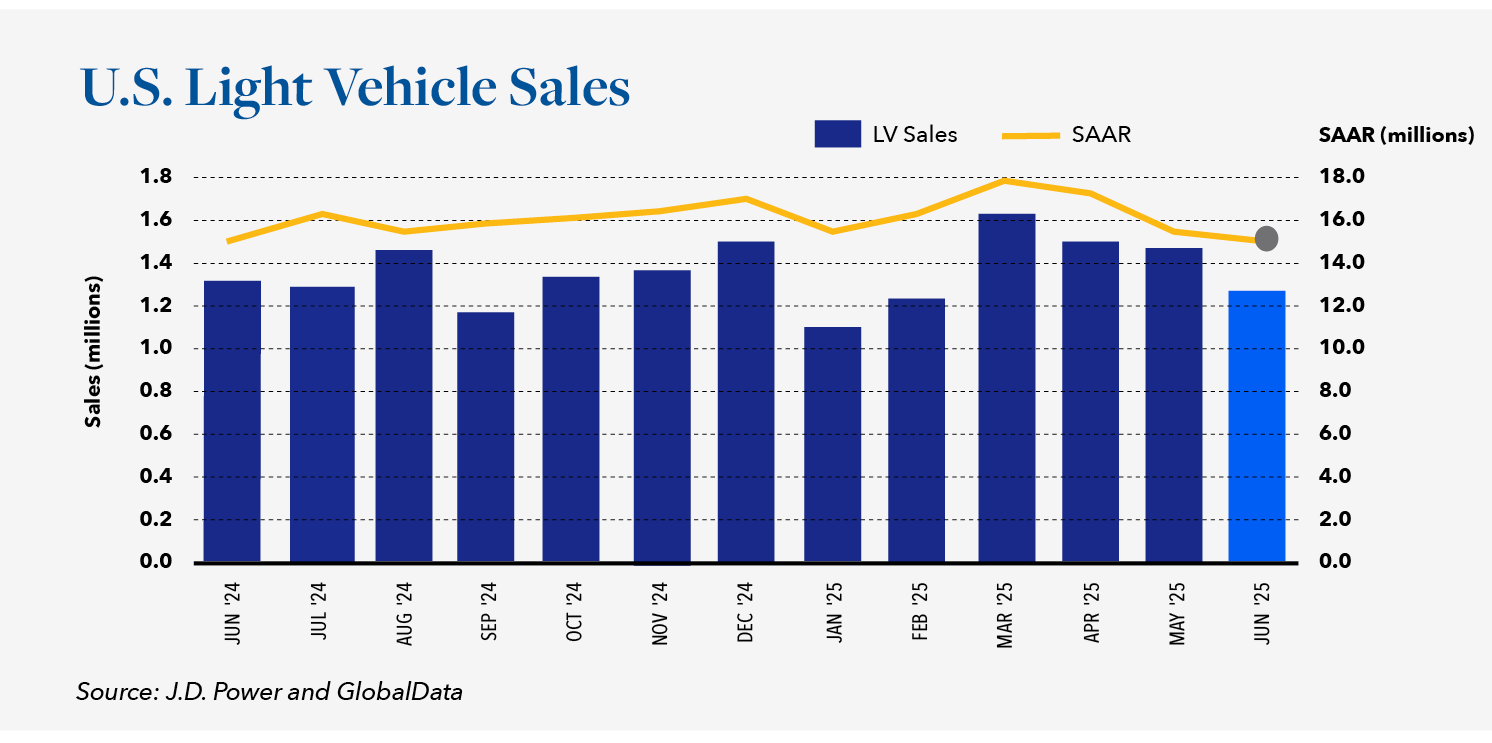
As expected, the SAAR for May and June has fallen back to 15.3 million and 15.2 million vehicles, respectively. Together with the SAAR of 17.3 million for April, the overall SAAR for the second quarter was a respectable 16.1 million vehicles, only down slightly from the 16.4 million vehicles posted for the first quarter. At the outset of the year, most industry insiders were hopeful for a modest improvement over the 16 million vehicles sold in 2024. While on the surface, the sales results thus far appear to be on target, those same industry insiders now see a market closer to 15.5 million vehicles, a decrease of 3% from 2024. In anticipation of a significant drop in sales in the second half of the year, the National Automobile Dealers Association has cut its full-year forecast to 15.3 million units. In a recent survey of automobile dealers, Cox Automotive found that dealers are currently less optimistic about the next three months than they were three months ago. Perhaps telling is that the response from independent dealers can be characterized as pessimistic, expecting the future market to be weak.
In situations like this, manufacturers have been quick to use incentives to stoke demand, and the global pandemic was no exception. There were nearly 4 million vehicles on dealer lots at the time, but sales incentives exceeding $4,500, or 12% of the manufacturer’s suggested retail price (MSRP), were very effective at reducing costly inventory. By the time the realization set in that replenishing inventory was a problem, it was too late, and inventory had fallen below 1 million vehicles, and it was not unusual for consumers to pay above MSRP to get the vehicle they wanted. Dealers are currently sitting on less than 3 million vehicles, and the current trade war has disrupted the supply chain. Normally, at this time of year, the manufacturers begin to increase sales incentives to clear older inventory prior to the introduction of the new model year. For now, at least, manufacturers appear to be content to offset the impact of rising tariffs by tempering sales incentives as opposed to raising prices. At only $2,727 per vehicle, or 5.2% of MSRP, this level of incentive is unusually restrained by historical standards. At this point, manufacturers are more likely to wait for the rollout of their 2026 model year line-up to adjust pricing for the proposed tariffs. If that is the case, manufacturers will need more clarity soon as to how much and when the tariffs will take effect because some tariff mitigation strategies will no doubt involve tool changes.

This publication has been prepared solely for the use of clients and professional associates of The Hilco Organization. No warranty is given as to the accuracy, completeness of the information or opinions provided in this publication. The publication should not be used as specific advice and is intended for general information purposes only.