When the Walls Are Sacred: The Financial Crisis Facing Jewish Institutions and the Path Forward

October 2026
American Jewish communal life has always been organized around sacred space. The synagogue, the day school, the Jewish Community Center, the senior residential community — these are not merely buildings. They are the physical embodiments of the values of our Torah and the architecture of Jewish continuity. Yet today, Jewish institutions of every denomination and size are confronting a financial reckoning that threatens their ability to sustain those sacred walls — and the communities gathered within them.
Over four decades as a congregational rabbi, I have witnessed the extraordinary creativity and resilience of the Jewish community. I have also watched, with growing concern, as the financial models that once sustained our institutions have buckled under the weight of demographic change, shifting donor patterns, and rising operational costs. The crisis is real, it is urgent, and it is not beyond our capacity to address — if we act with wisdom, honesty, and courage.
A Community at a Crossroads
The Talmud teaches: כל ישראל ערבים זה לזה — “All Israel is responsible for one another.” We built institutions not for profit, but for purpose: to educate our children, to care for our elderly, to gather for prayer, and to transmit our tradition to the next generation. The 2020 Pew Research Survey documented what many already sensed: declining affiliation, geographic dispersal, and a younger cohort of Jews with weaker ties to formal institutional life. These demographic pressures arrive precisely when security costs, deferred maintenance, and competitive professional compensation place relentless upward pressure on budgets. Across the country, Jewish communities are sitting on significant real estate assets — synagogue campuses, day school buildings, JCC facilities, senior living complexes — built for a different era and a different vision of communal life. These properties represent both a burden and an extraordinary, underutilized opportunity.
The Silence of Institutional Cognitive Dissonance
There is a peculiar and dangerous form of institutional blindness that afflicts organizations under financial stress — one that psychologists call cognitive dissonance and that Jewish tradition might recognize as a failure of חשבון הנפש, of honest self-accounting. It is the conviction, held with remarkable tenacity even in the face of contradictory evidence, that what has happened to other institutions — the merger, the campus sale, the closure — simply cannot happen to us.
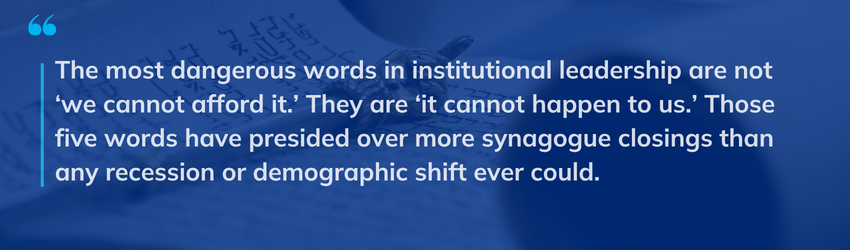
This blindness operates at every level. Board members who chaired the capital campaign that built the sanctuary cannot approach its restructuring as a dispassionate financial question — it is a question about the meaning of their own Jewish life. Professional staff tempted to manage the crisis quietly, hoping the next major gift will make the hard conversation unnecessary for one more year. Congregants for whom the walls hold the imprint of every lifecycle moment the community has shared — and for whom any change to the physical space feels like an assault on memory itself.
All of this is entirely understandable. It is also, in the current environment, genuinely dangerous. The institutions that have navigated this moment successfully are those whose leaders found the courage to name the cognitive dissonance clearly and begin the hard conversations before the crisis forced their hand. The antidote is the ancient Jewish practice of חשבון הנפש — honest self-examination — conducted not in despair but in the spirit of possibility. The institution that looks clearly at its financial reality is not giving up. It is, in the deepest sense of our tradition, choosing life — ובחרת בחיים.
It Is Not Too Late
The cases are multiplying — suburban synagogue campuses built for eight hundred that now serve two hundred, day schools holding properties worth far more than their balance sheets suggest, federations recognizing that independently operated campuses with their own facilities staff and utility bills are no longer sustainable. Jewish senior living communities sitting on real estate of extraordinary market value while struggling to meet regulatory and labor costs. The pattern is consistent: institutions that wait until the crisis forces action find their options have narrowed to a painful few. The merger that might have been a strategic partnership becomes a desperate necessity. The property sale that might have generated endowment liquidity becomes a distressed transaction at a fraction of fair market value.
Whether your institution is healthy, stressed, or distressed, the path forward requires the same starting point: an honest, independent assessment of your real estate assets and their genuine current market value. From that foundation, a range of powerful tools becomes available — sale-leaseback arrangements that convert illiquid equity into operational resources while preserving use of the space; long-term ground leases that unlock value for alternative, compatible uses; campus consolidations and shared-facility agreements that reduce costs without sacrificing mission. Jewish institutions also carry something the purely financial analysis cannot fully capture: a network of communal relationships, a tradition of mutual responsibility, and a faith that has survived four thousand years by pairing unswerving commitment to core values with a remarkable capacity for adaptation.
The walls of our institutions are sacred. Keeping them standing — or wisely deciding how to build new ones — is among the most important work of this generation of Jewish communal leadership. The Psalmist writes: “זה היום עשה היי ה — This is the day that the Lord has made.” The decisions made in the months ahead will determine which institutions thrive — and which ones discover that the very thing that leaders believed only happened to others became their fate.
*The views and opinions expressed are provided for general informational and educational purposes only and are subject to change without notice. This publication does not constitute investment, tax, or legal advice, nor should it be relied upon as a recommendation regarding any course of action. The information contained herein is provided “as is” without any representations or warranties as to its accuracy, adequacy, or completeness. While Hilco Trading, LLC has exercised reasonable care in preparing this publication, it assumes no liability for any actions taken or not taken based on its contents. Past performance is not indicative of future results.