Why the U.S. Auto Market Missed the Global EV Tipping Point and What That Means for Lender Risk

September 2026
Five years ago, automakers were racing toward all-electric futures. GM even had a public target of selling only electric vehicles by 2035. Today the industry has booked roughly $65 to $70 billion in EV-related write-downs since late 2025, concentrated largely among automakers that bet heavily on the U.S., where demand and EV sales are falling even as the rest of the world’s EV sales climb. That split says something important about what actually moves this market, and it is not brand strategy or climate policy. It is the price of a barrel of oil.
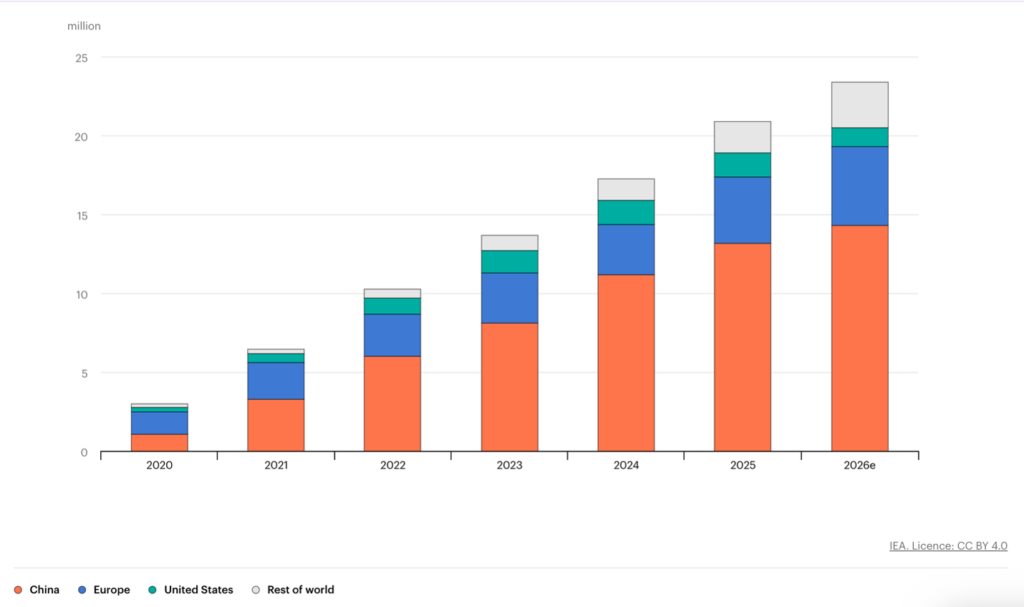
There is a long-standing theory that a sustained rise in the cost of fossil fuels is the real tipping point that pushes renewable energy technologies like EVs from development into full deployment. In that environment, EVs stop needing rich incentives to compete on price, homeowners install solar without waiting on a subsidy check, and struggling transit systems suddenly have enough riders to cover their operating costs. This year gave that theory a live test. The war between Iran and the U.S.-Israel coalition, which began in February 2026, disrupted roughly a fifth of global oil and LNG trade moving through the Strait of Hormuz, an event the International Energy Agency called the largest supply disruption in the history of the global oil market. U.S. gasoline, which sat near $2.98 a gallon in late February, climbed past $4 by April. The IEA reported that global EV sales, which had actually fallen 8% in the first quarter, rebounded 35% in the second quarter and hit record levels in 50 countries, pushing the global EV share of new car sales toward 29% for the year. Reuters reported that EV sales accelerated again across Europe in July, with high oil prices, subsidies and cheaper models pulling drivers out of combustion cars. In South Africa, EV sales more than quintupled in the first half of the year.
The U.S., however, is the exception. North American EV sales fell roughly 20% year over year in the first half of 2026, with GM and Ford’s own battery-electric sales falling even faster than the overall market. So, while the EV tipping point did, in fact, occur, the U.S. has been largely left behind. Why? Because the policy support that initially made EVs competitive on price expired at precisely the same moment that fuel got unexpectedly more expensive. The $7,500 federal tax credit ended September 30, 2025, and Cox Automotive data shows U.S. EV deliveries fell 27% year over year in the following quarters. Ford took a $19.5 billion charge tied to scaling back its Model e unit, with total related costs projected near $20.9 billion through 2027. GM booked $6 billion in Q4 2025 charges and another $1.1 billion in Q1 2026, on top of a prior $7.6 billion hit. Honda, Nissan, Hyundai, Kia, Volvo, Jeep, Ram, Lamborghini and Polestar have all canceled, delayed or repositioned EV models. Nissan scrapped two electric SUVs planned for its Canton, Mississippi plant as part of its Re:Nissan restructuring, a plan that also calls for 20,000 layoffs and seven plant closures worldwide.
To be clear, this is a narrowing as opposed to a full retreat. BMW’s Neue Klasse platform is still rolling out through 2027. Porsche is targeting a refreshed Taycan for 2027. Hyundai is keeping U.S.-assembled Ioniq 5 and Ioniq 9 production running even as it pulls imported EV models. GM actually gained EV share in the U.S., moving to 13% from about 10%, largely by picking up volume from competitors who pulled back faster. The survivors are consolidating around fewer, better-funded platforms rather than broad lineups, and that consolidation is exactly the kind of shift that changes which borrowers hold the strongest collateral a year from now.
Charging infrastructure has not kept pace with the ambition behind it, either, which compounds the U.S. gap. The federal NEVI program authorized $5 billion for a national fast-charging network, but as of late 2025 fewer than 400 ports had been built. A funding freeze in February 2025 stalled state programs for roughly seven months, and a January 2026 report found states had spent only about 2%, or $94 million, of the $4.4 billion made available. Congress rescinded roughly $503 million from the program in early 2026, leaving another $1.4 billion in obligated state funds in question. Revised guidance now allows off-corridor and medium- and heavy-duty charging investment, which may matter more to fleet lenders than to retail buyers, but the core promise, a reliable national fast-charging backbone, is still years behind where it was supposed to be.
Trade policy has gotten more volatile this summer, and it belongs in this conversation because it impacts the North American production footprint. The first USMCA joint review on July 1 was not renewed, but the agreement and its current rules of origin remain in force through 2036 under a new annual review cycle. Subsequently, the U.S. and Mexico moved into formal renegotiation while talks with Canada broke down entirely on August 22, triggering 50% U.S. tariffs on roughly $20 billion of Canadian goods and a retaliatory response from Ottawa set to begin September 8. U.S. auto factories were reportedly running at 58% of capacity heading into that breakdown, the lowest level in more than four years.
Canada has already diverged from Washington on China policy, replacing a 100% tariff on Chinese-made EVs with a much smaller 6.1% tariff, available for the first 49,000 Chinese EVs imported each year. Tesla is already using that opening to bring Model 3s built at its Shanghai factory into Canada at the lower rate. That’s a notable gap in what was supposed to be a unified North American wall against Chinese EVs, and it comes at the same time the U.S. and Canada are clashing over tariffs on each other’s goods. Any lender with cross-border exposure should be aware that USMCA qualified goods may still incur the new 25% – 50% Section 338 tariffs.
With EV sales cooling domestically, hybrids are absorbing much of the demand automakers once expected EVs to capture. Hybrid vehicles reached a record 16% share of U.S. new vehicle sales in the second quarter of 2026, more than double the battery-electric share, and one industry forecast projects hybrids could reach roughly a third of the market by 2034.
Dealer inventory isn’t a simple story of a growing glut. New-vehicle inventory stood at roughly 2.97 million units and 88 days’ supply in November 2025, down slightly from a year earlier. But floorplan costs still climbed. Net expense per vehicle jumped an estimated 39% in the second quarter of 2025, as higher interest rates and slower turnover made it more expensive to carry cars on the lot. EV inventory shows a similar split. Automakers have pulled back sharply, so overall EV inventory has shrunk. But older EV models are still aging on lots even as newer ones sell. And used EV values, aside from Tesla, have dropped much faster than the rest of the market. That’s a real collateral risk for any lender still pricing EV inventory off broad market averages.
Globally, the picture runs almost opposite to the U.S. story. China’s EV and PHEV production has built overcapacity estimated at up to 20 million vehicles by the end of 2025, roughly double domestic demand, and a price war has followed, with BYD’s own first-quarter profit falling 55% even as volumes held up. Squeezed at home, Chinese automakers are pushing aggressively into overseas markets. Passenger car exports rose nearly 30% year over year, and BYD’s first-half overseas sales jumped 70%. Europe has absorbed much of that volume: Chinese brands’ EU battery-electric share rose from roughly 9% to over 14% in the first five months of 2026 despite tariffs as high as 35%, partly by shifting toward plug-in hybrids that face lighter duties. Chinese automakers have now overtaken Japanese brands in European passenger car sales for the first time. Chinese models already account for more than 80% of EV sales in markets like Argentina, Indonesia and South Africa.
Global Electric Car Sales 2020 – 2026
The U.S. remains the one major market Chinese EVs have not cracked, and that isn’t an accident. A 100% tariff on Chinese-made EVs has been in place since May 2024. Since March 17, 2025, a Commerce Department rule has also barred Chinese- and Russian-linked software in vehicle connectivity and automated driving systems sold in the U.S., with hardware restrictions phasing in by 2029, a rule that applies even to U.S.-built cars if the software has ties to China or Russia. The concern behind it is straightforward: a connected vehicle collects location data, camera footage and driving behavior, and officials are worried that data could reach a foreign government or that a foreign adversary could remotely disable or manipulate vehicles at scale.
A bipartisan Senate bill introduced this year would go further and ban the sale or resale of any connected vehicle tied to China, Russia, Iran or North Korea outright. Underneath all of this sits a broader shift that applies regardless of powertrain: vehicles are becoming software-defined platforms with over-the-air updates, subscription features and, increasingly, Level 3 autonomy in production models, which is precisely why the software provenance question carries so much weight.
Taken together, these developments carry a common implication for lenders with exposure across the automotive and EV supply chain: Many borrowing bases were built around a market that never materialized as envisioned. The fact that EV inventory is turning slower and depreciating faster than ICE and hybrid stock is a good reason to take a fresh look at advance rates and audit frequency on EV-heavy floorplans. Any borrower whose supply chain touches North America should also be asked to provide details pertaining to any Chinese content, batteries or connectivity hardware, as well as any components moving through Mexico or Canada. That scrutiny matters given the connected vehicle rule and the recent direction of USMCA renegotiation.
Used EV values have moved more with oil prices than new EV demand has, which also matters for anyone marking collateral. With tariff policy, trade agreements and federal incentives all in flux at once, lenders may want to consider moving away from redetermining borrowing bases on a fixed schedule and shift toward a more flexible, as-needed approach. If any of this is already showing up in a borrower’s numbers, it’s worth a conversation before it shows up in a covenant test.
The current environment underscores the importance of selecting a partner with the experience, judgement, and execution capabilities necessary to navigate uncertainty. Heightened geopolitical risk, elevated energy and gas costs, and the potential for further economic volatility could place pressure on a company’s operating performance and financial position. In this environment, the right service provider can play an important role in identifying potential risks early, providing thoughtful and defensible analysis, and helping lenders make informed decisions. With this in mind, we encourage you to reach out to Hilco Global Professional Services to gain meaningful and actionable insight during this complex period. We are here to help.
*The views and opinions expressed are provided for general informational and educational purposes only and are subject to change without notice. This publication does not constitute investment, tax, or legal advice, nor should it be relied upon as a recommendation regarding any course of action. The information contained herein is provided “as is” without any representations or warranties as to its accuracy, adequacy, or completeness. While Hilco Trading, LLC has exercised reasonable care in preparing this publication, it assumes no liability for any actions taken or not taken based on its contents. Past performance is not indicative of future results.