
Working Toward a Win You Won’t Lose

Consanguinity and Affinity
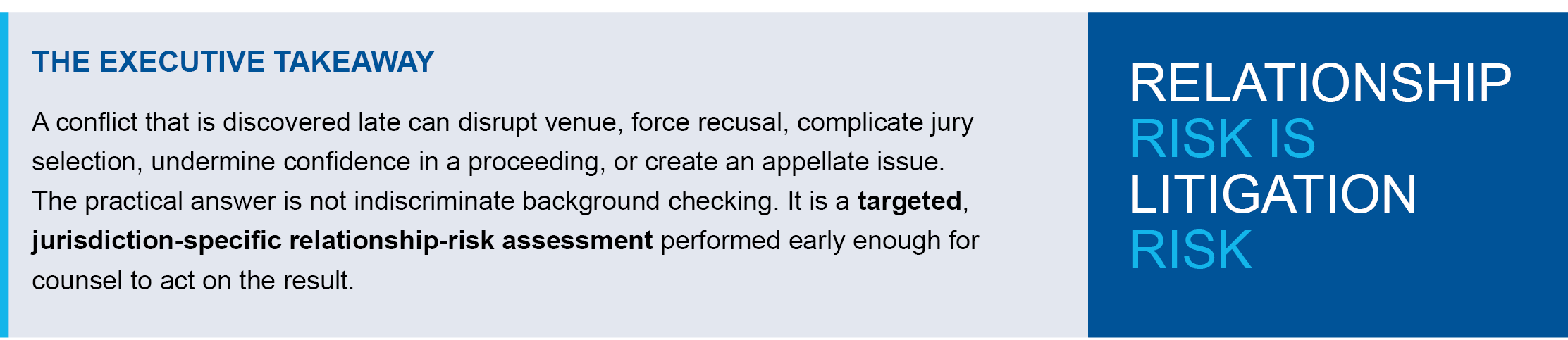
In 2015, we exclaimed: one sounds like your cable supplier, the other a word you might challenge in Scrabble, but we emphasized they were words to know. They could be important elements in determining the outcome of high profile lawsuits or even whether a decision could withstand appeal. Our 2015 whitepaper not only explained the relevance of these terms, we showed how you could apply them in key situations.
Why Revisit This Now?
The core risk identified a decade ago has not disappeared. If anything, litigation has become more data-rich, more interconnected and more exposed to public scrutiny. At the same time, the governing framework has evolved. Most notably, the Supreme Court of the United States adopted its own Code of Conduct in November 2023, eliminating one of the most conspicuous gaps noted in the original article. Federal guidance also now expressly recognizes that recusal considerations applicable to a spouse should be considered for a person with whom a judge maintains both a household and an intimate relationship – marriage certificates alone don’t determine a recusal obligation.
The Issue in Plain English
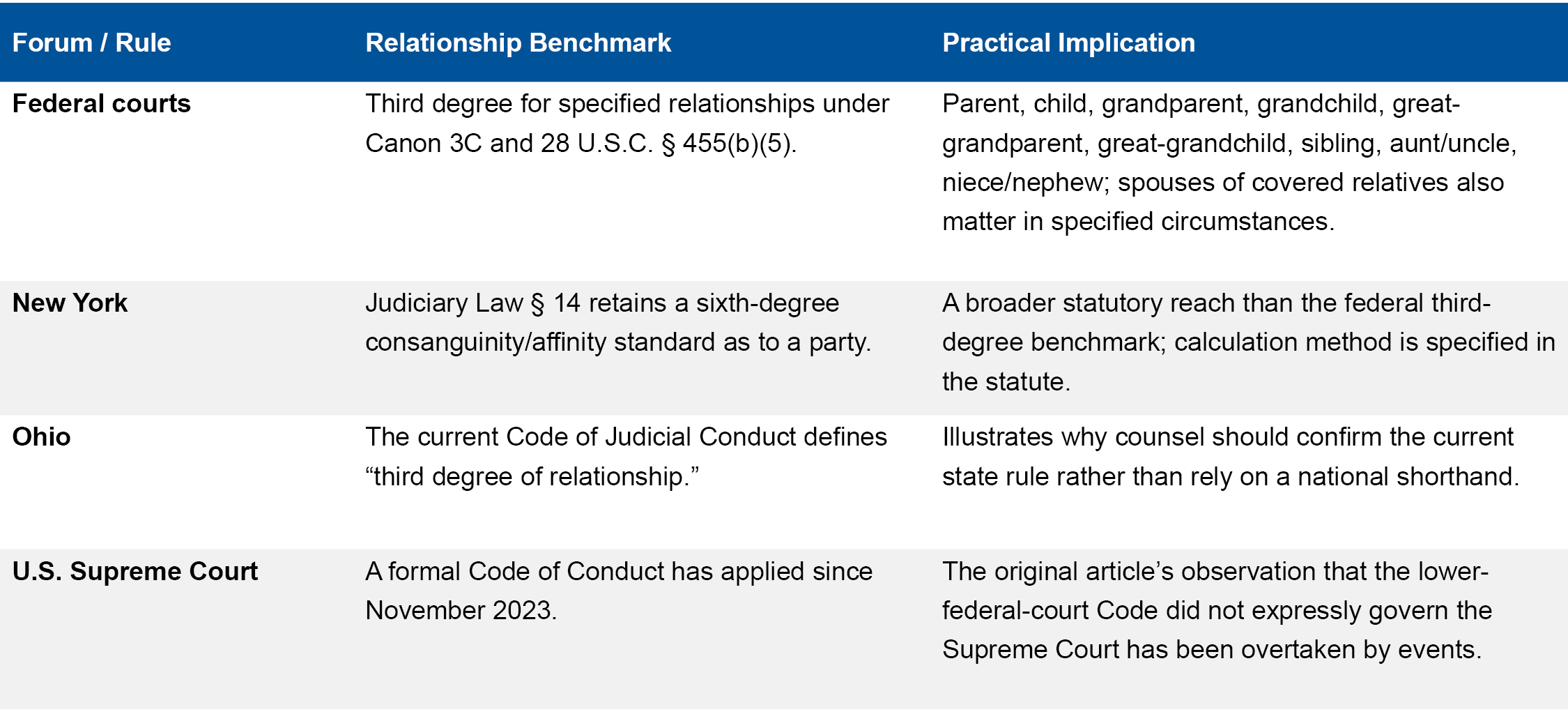
Consanguinity means kinship by blood. Affinity generally refers to relationships created through marriage. Courts and ethics rules often measure how close a family relationship is by “degrees,” but the relevant degree, the method of calculation and the consequences of the relationship vary by jurisdiction and by issue.
That variability is the point. A relationship that is immaterial under one rule may matter under another. Counsel should therefore avoid treating a generic family-tree search as a substitute for a legal analysis of the applicable recusal, juror-challenge, disclosure or ethics standard.
Where Relationship Risk Can Surface
- A judge’s (or judge’s clerk’s) relationship to a party, or to an officer, director or trustee of a party.
- A judge’s or spouse’s relationship to a lawyer, material witness or person with an interest that could be substantially affected by the outcome.
- Juror relationships to parties, counsel or witnesses, where state law or local practice permits a challenge for cause.
- Relationships involving court-appointed professionals, judicial employees or other participants whose independence can become relevant.
- Large class, mass-tort and multi-party matters, where the sheer number of interested people increases the probability of an undisclosed connection.
The Rules Still Differ Materially
What Has Changed Since the Original Article
- The Supreme Court Now Has a Written Ethics Code.
In 2015, the absence of a Supreme Court-specific code was a notable feature of the landscape. The Court adopted a Code of Conduct for Justices on November 13, 2023. Its principles include avoiding impropriety and the appearance of impropriety and addressing family, social, political, financial and other relationships that could influence official conduct.
- “Family” Analysis Is No Longer Confined to Formal Labels.
The current federal Code’s commentary states that recusal considerations applicable to a judge’s spouse should also be considered with respect to a person other than a spouse with whom the judge maintains both a household and an intimate relationship. That makes a purely marriage-certificate-driven approach incomplete in some federal matters.
- Class Actions Require a More Nuanced Inquiry.
The Judicial Conference’s current Advisory Opinion No. 90 addresses whether a judge must investigate to determine whether third-degree relatives might fall within a Rule 23(b)(3) class. The modern guidance underscores that the existence of a large potential class does not translate into an unlimited affirmative duty to investigate every possible relative. For litigants, the lesson is to define the relevant population and legal trigger before launching research.
- Public-Record and Data Capabilities Are Far Stronger.
Relationship research can now combine litigation and regulatory records, corporate registrations, property and UCC records, campaign and political-disclosure records, professional biographies, media archives, structured investigative databases, mapping tools and data analytics. Researchers have access to archival sources, cemetery records, and historical newspapers that reveal long forgotten connections. These capabilities make targeted testing faster—but also increase the need for disciplined scoping, source validation and privacy-sensitive handling. Moreover, skillful use of artificial intelligence tools can be used to determine relationships that used to take longer to understand.
- Reputational Consequences Travel Faster.
A technically remediable conflict can become a broader credibility problem when discovered late. Boards, investors, regulators, the press and other stakeholders may focus not only on whether a rule was violated, but on whether the parties had a defensible process for identifying and escalating conflicts.
A Practical Relationship-Risk Protocol
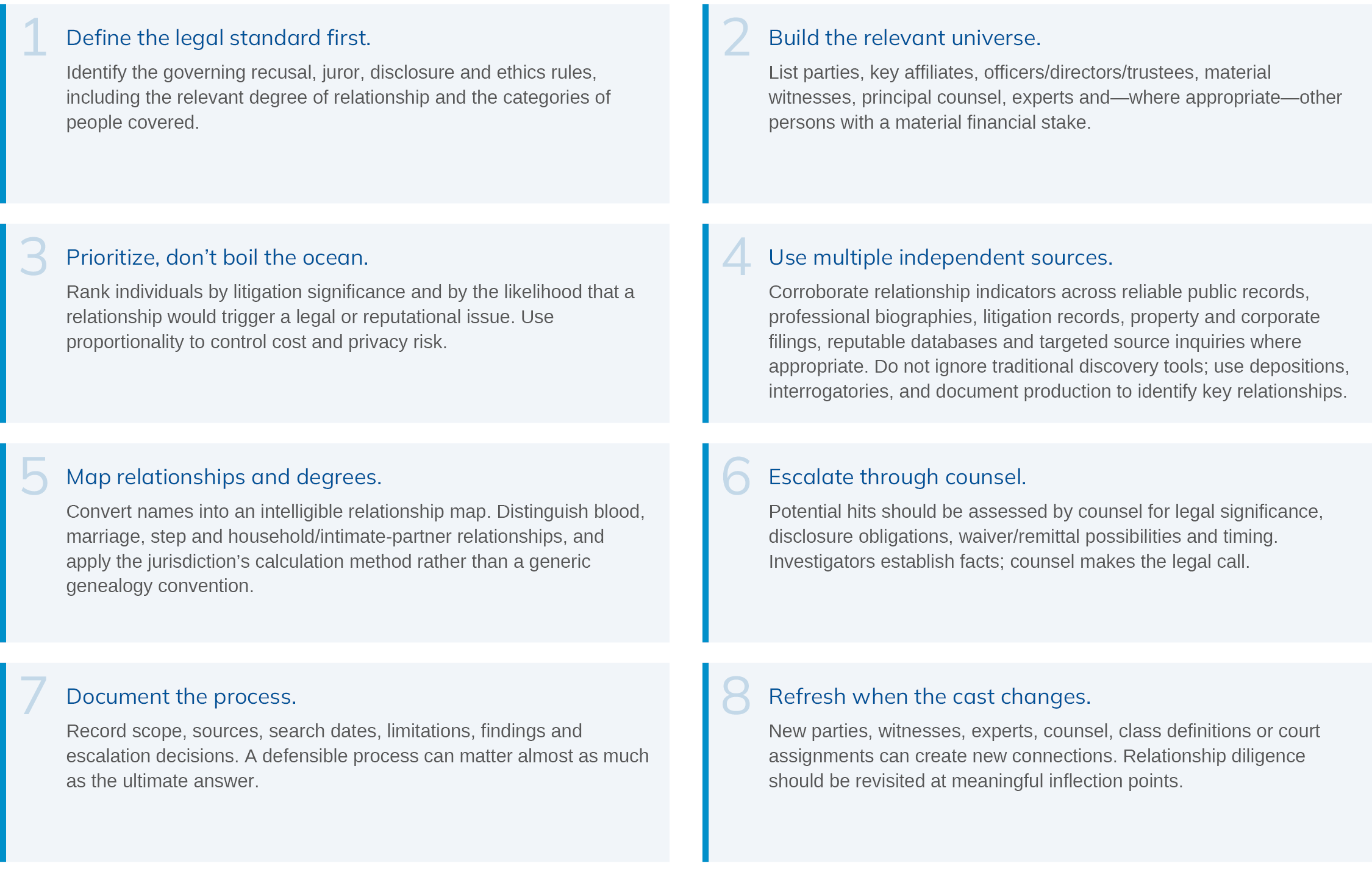
For significant litigation, arbitration or regulatory matters, counsel can treat relationship risk as a discrete diligence workstream rather than an afterthought.
Illustrative Investigative Approach
Consider a large environmental or mass-claim matter in which potential claimants are defined by geography rather than by a conventional political boundary. A useful approach may be to identify addresses within the relevant zone, determine who occupied those addresses during the relevant period, and then test the resulting population for relationships that counsel has determined could matter. Mapping and investigative databases can narrow the population; public records and targeted corroboration can then resolve potential connections. The point is not to investigate everyone indiscriminately—it is to create a repeatable method that links the factual population to the governing legal standard.
Records That May Reveal Relationships
- Corporate and assumed-name filings, including family-owned businesses and shared officer/director roles.
- Real-property, vehicle and other titled-asset records that may identify co-ownership or household connections. Real estate records are especially good at stating marital status.
- UCC and financing records that can reveal guarantors, co-borrowers or family-supported transactions.
- Court records, including probate, divorce and other proceedings where legally and ethically appropriate.
- Campaign, lobbying and public financial-disclosure records.
- Professional biographies, obituaries, media archives and other reputable open-source materials.
- Investigative databases and analytics used as leads, with material findings corroborated against primary or otherwise reliable sources.
- Electronic evidence and other documents may show relationships and important events.
The Operating Principle:
Search broadly enough to avoid a surprise, but narrowly enough that every search is tied to a defined litigation risk.
Questions Executives and Counsel Should Ask
- Have we identified the specific relationship rules that apply in this forum?
- Do we know which people—not merely which corporate entities—matter to the analysis?
- Have material relationship indicators been independently corroborated?
- Is there a clear protocol for escalating a potential conflict before it becomes a procedural or reputational problem?
- Will the diligence be refreshed if the judge, counsel, witnesses, experts, parties or class definition changes?
The Bottom Line
Consanguinity and affinity remain old words for a modern risk. The terminology can sound arcane, but the business consequence is straightforward: an undisclosed relationship can destabilize a proceeding after substantial time and money have been invested. The rules are not uniform, family structures do not always fit historic labels, and the relevant population can be enormous.
The strongest response is a disciplined combination of legal scoping and investigative fact development. Done early, relationship-risk diligence can help counsel address conflicts transparently, protect the integrity of the process and reduce the chance that a hard-won result becomes a fleeting victory.
How Hilco Global Can Help
Hilco Global’s Global Investigations & Dispute Resolution professionals advise boards, law firms, investors and management teams in complex matters where the facts are unclear and the stakes are high. Relevant capabilities include reputational and integrity due diligence, public-record and business-intelligence research, data analytics, litigation support, forensic accounting and dispute advisory. In relationship-risk matters, the team can work with counsel to define the relevant population, develop and corroborate relationship evidence, map connections, document methodology and support defensible decision-making.
Sources and Update Notes:
- Original article: Kristofer Swanson and Rob Gardner, “Working towards a win you won’t lose: the continuing relevance of consanguinity and affinity,” ABA Criminal Justice Section, White Collar Crime Committee Newsletter (Winter/Spring 2015), reprinted by Charles River Associates in 2016.
- Code of Conduct for United States Judges, Canon 3C, Administrative Office of the U.S. Courts (current online version accessed August 2026); see also 28 U.S.C. § 455.
- Code of Conduct for Justices of the Supreme Court of the United States (adopted Nov. 13, 2023).
- N.Y. Judiciary Law § 14 (current online text accessed August 2026).
- Ohio Code of Judicial Conduct (effective Feb. 12, 2026), including definition of “Third degree of relationship.”
- Committee on Codes of Conduct Advisory Opinion No. 90, Duty to Inquire When Relatives May Be Members of Class Action (Guide to Judiciary Policy, Vol. 2B, Ch. 2).


