Beyond Traditional Credit Review: Forensic Red Flags In Private Credit

August 2026
In private credit, value often disappears before default occurs. Recent market indicators suggest that many private credit borrowers are under increasing pressure. Growth has slowed from post-pandemic highs, while the percentage of borrowers reporting declining sales and EBITDA has increased during the past two years. Approximately 15 per cent of private credit borrowers are reportedly not generating sufficient EBITDA to cover interest payments. Regulators are also making the fraud lens more explicit. In May 2026, David Woodcock, director of the Division of Enforcement at the US Securities and Exchange Commission (SEC), said the agency would continue targeting fraud and manipulation “in all its forms.” He identified liquidity, fees, valuations, and conflicts of interest as areas of concern in private funds and said the Division would remain active in matters involving fraudulent valuations and mismarking. Woodcock also singled out private credit, noting stress in some portfolios and broader developments the SEC is monitoring.
The big question
The practical question for lenders is no longer whether a borrower is merely stressed or may become stressed. It is whether the reporting package, collateral base, cash movement, and transaction structure are complete, accurate, and telling the truth before capital is committed or recovery options narrow. Traditional underwriting and credit monitoring are designed to evaluate reported performance and risk. Specialised forensic analysis addresses a different question: whether the information on which those judgments rely can be independently validated. That analysis moves beyond management-prepared reports and into evidence such as invoices, collections, borrowing-base support, lien records, loan tapes, servicer reports, bank activity, and the economic substance of side arrangements. In asset-backed and collateral-dependent structures, lender protection depends not only on cash flow, but also on whether pledged collateral exists, is eligible, is collectible, is controlled, and has not been overstated, redirected, or pledged elsewhere.
When private credit risks require specialised forensic review
The following framework conditions may warrant independent forensic validation.
These warning signs are not proof of fraud or impairment. Rather, they identify situations in which independent forensic validation may materially improve a lender’s understanding of risk in a more timely fashion.
- Borrower reporting that cannot be independently reconciled to source records or prior-period activity.
- Collateral or borrowing-base values that require validation against invoices, inventory, collections, lien records, or loan-level data.
- EBITDA adjustments that materially influence leverage or debt-services conclusions but depend on assumptions rather than recurring cash performance.
- Covenant waivers, payment-in-kind (PIK) conversions, deferrals, or amendments that may delay recognition or underlying liquidity pressure.
- Side agreements, unusual terms, or off-book obligations that may change the economics of the credit.
- Related-party activity that may move cash, assets, liabilities, or enterprise value outside the borrowing group.
- Valuation marks or net asset value assumptions that may not reflect borrower-level deterioration or current recovery evidence.
- Patterns suggesting manipulation, cash diversion, double-pledging, management override, or other conduct that cannot be explained by ordinary operating stress.
Reliability of Borrower Reporting
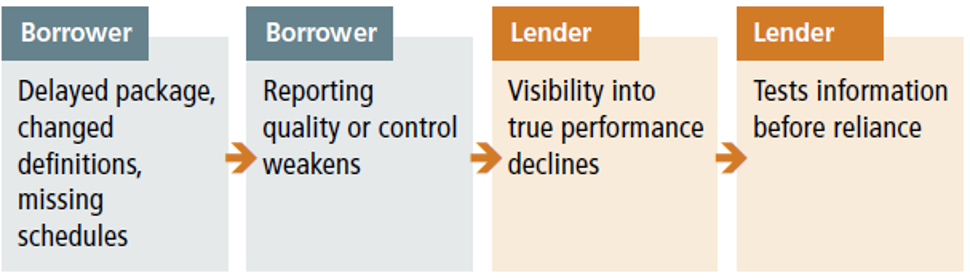
Warning signs may include delayed financial packages, unexplained changes in reporting formats, inconsistent operating metrics, unsupported account reconciliations, missing schedules, or information that cannot be reconciled to prior periods. These issues may indicate weakening internal controls, reduced management oversight, or limitations in the borrower’s ability to provide reliable information. The concern is not simply whether a reporting package is delivered, but whether it is complete and accurately reflects the borrower’s operating condition. Independent procedures may include tracing reported results to general ledger detail, bank activity, customer or vendor support, and other source records rather than relying exclusively on management representations. Recent market data indicates that some private credit-backed borrowers are experiencing elevated leverage and weakening operating performance. Nearly 30 per cent of companies with debt maturing before year-end 2026 reportedly had leverage exceeding 10 times or negative EBITDA and had received an assessment score of ccc+ or below, underscoring the importance of identifying deterioration before recovery options become limited. These conditions increase the importance of evaluating the reliability of borrower reporting, because a highly leveraged borrower may have both the incentive and the need to present performance in the most favourable possible light.
Collateral and Borrowing-Base Integrity
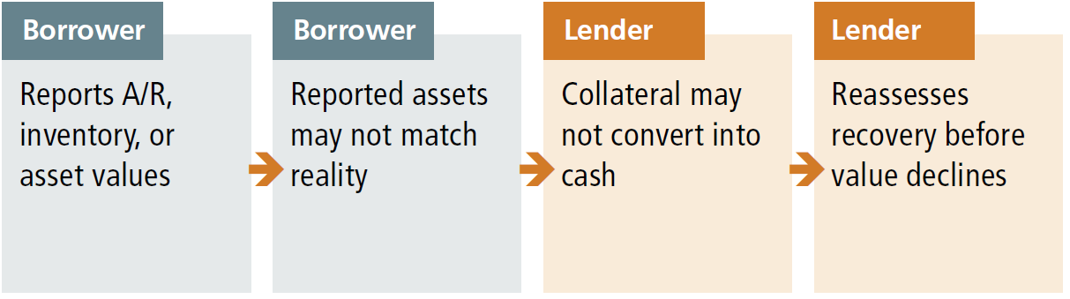
Collateral concerns may arise when reported assets do not reflect economic reality. Examples include overstated accounts receivable, unsupported customer balances, slow-moving inventory presented as current, undisclosed restrictions on assets, or asset values inconsistent with business activity. In 26 real-world cases analysed by the Secured Finance Network’s 2026 Fraud Task Force, accounts-receivable and billing manipulation appeared in approximately 58 per cent, inventory re-aging in 35 per cent and cash diversion in 12 per cent. Effective collateral review requires more than confirming reported balances. Borrower reports, inventory records, aging schedules, customer concentrations, and cash collections should be evaluated together, and, where appropriate, tested to third-party or transactional evidence. The objective is not only to verify reported asset values, but also to determine whether collateral exists, is eligible, is properly controlled, and can realistically be converted into cash if recovery efforts become necessary. Specialised forensic and operational due diligence can help lenders move from document-based review to more holistic, evidence-based verification. Procedures may include testing borrowing-base inputs against underlying invoices, customer remittances, inventory records, loan-level data, lien records, bank activity, and servicer reporting. This work can be performed during underwriting, through periodic monitoring, or when warning signs emerge. In asset-backed finance, the core question is not simply whether collateral is reported, but whether evidence confirms the lender’s expected rights and recoveries.
Earnings Quality and EBITDA Adjustments
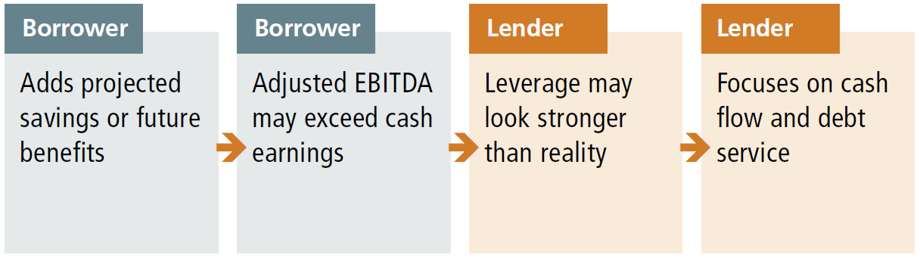
Adjustments may include projected cost savings, restructuring benefits, future growth initiatives, or other assumptions that have not yet been realised. While certain adjustments may be appropriate, reliance on optimistic assumptions can inflate earnings and reduce visibility into actual leverage. S&P Global found that add-backs averaged 29 per cent of management-adjusted EBITDA across the history of its study. Median leverage missed projections by 2.3 turns in the first year after deal inception and 2.7 turns in the second. Additionally, EBITDA addbacks can represent a substantial portion of management adjusted EBITDA, raising concerns regarding the quality and sustainability of projected earnings. When earnings quality declines, leverage metrics may appear stronger than the borrower’s actual financial condition, delaying recognition of credit deterioration. Independent earnings quality analysis can test whether adjustments are supported, achievable, nonrecurring, and consistent with cash performance. Distinguishing recurring operating performance from one-time or speculative adjustments provides a more reliable assessment of debt service capacity and long-term financial sustainability.
Covenant Changes and Delayed Stress Recognition
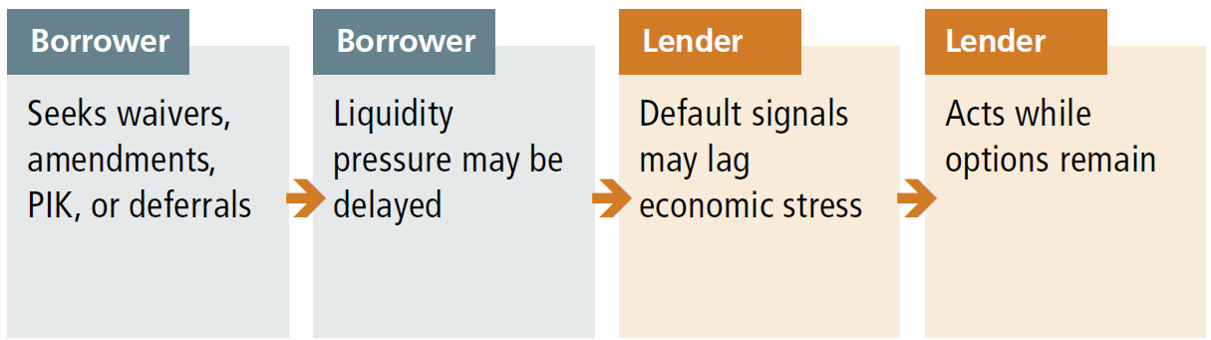
Borrowers experiencing pressure may seek amendments, covenant waivers, technical interpretations, or negotiated relief to avoid default triggers. While these actions may provide temporary support, repeated covenant modifications may indicate declining financial flexibility. PIK structures implemented at origination may reflect a deliberate financing decision aligned with borrower needs; however, PIK conversions, interest deferrals, or similar modifications introduced after origination may, in certain circumstances, provide early evidence of liquidity constraints or emerging financial pressure that traditional default metrics may not capture.
Side Arrangements and Off-Book Obligations
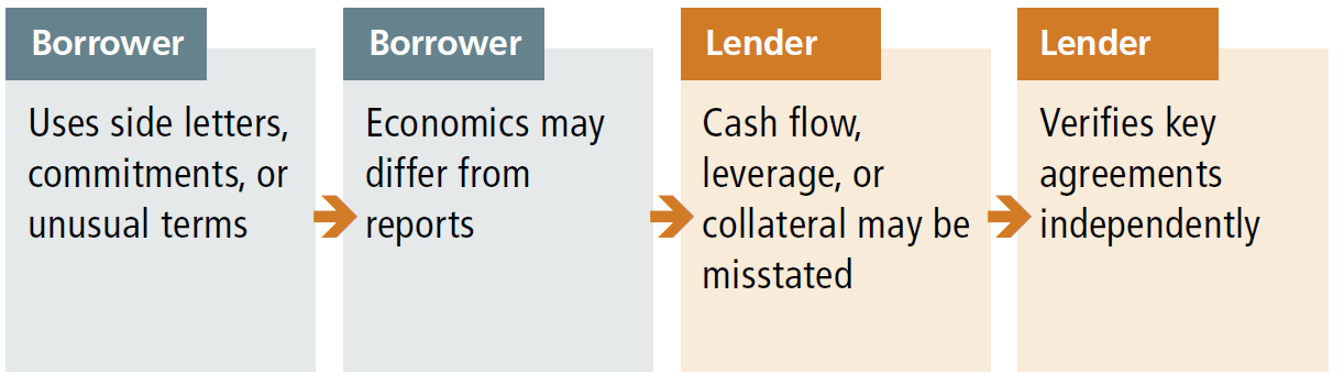
Potential concerns include side agreements with customers or suppliers, undisclosed commitments, off-book obligations, unusual contractual terms, or arrangements that shift economic value outside normal reporting channels. These arrangements may affect cash flow, liquidity, leverage, collateral value, or covenant compliance and may cause reported financial information to differ from the borrower’s actual economic position. Specialised review can compare executed agreements, correspondence, cash activity, and accounting treatment to determine whether the reported transaction economics are complete and accurate.
Related-Party Transactions and Value Leakage
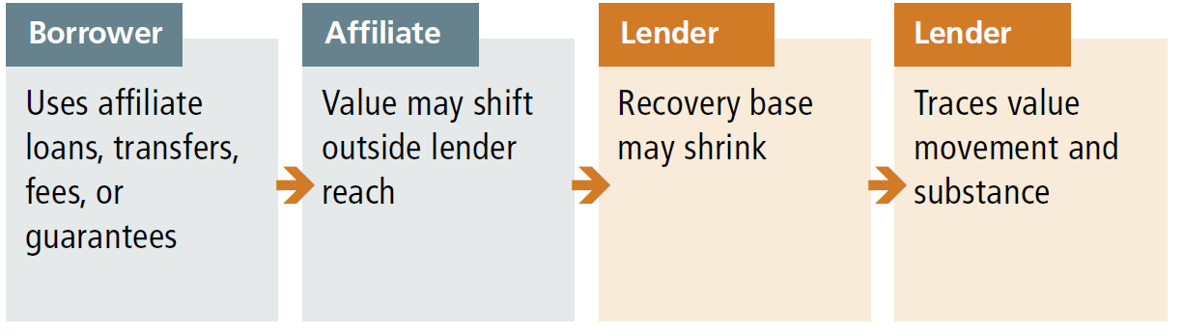
Potential concerns include loans between affiliated entities, transfers of assets or liabilities, management or service arrangements, guarantees, or other transactions involving related parties. These arrangements may create conflicts of interest, shift value among entities, or affect the allocation of financial resources. For private credit lenders, understanding related-party activity is
important when evaluating whether borrower resources, obligations, and financial relationships are accurately represented. Tracing cash flows, intercompany balances, contractual rights, and the economic substance of these transactions can help determine whether value has been transferred outside the borrowing group in a manner that could reduce lender recoveries.
Stale or Unreconciled Portfolio Valuations
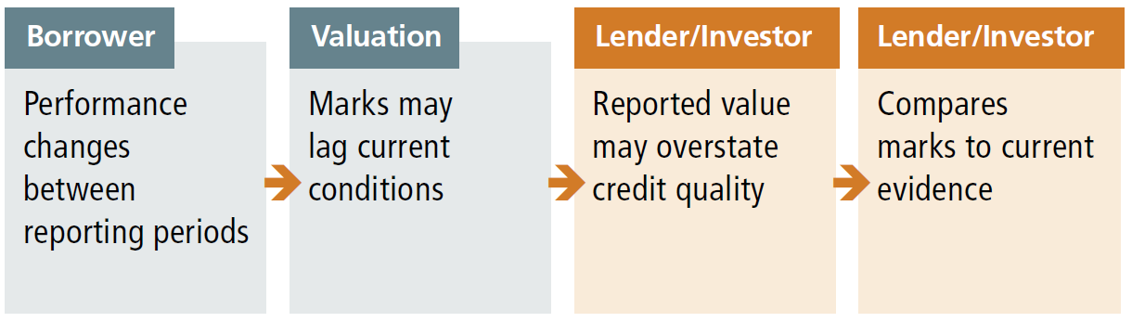
At the fund level, the concern is a carrying value that has not caught up with borrower deterioration. A valuation mark is the value assigned to a loan; NAV reflects the value of the fund’s assets after liabilities. Independent analysis can compare valuation assumptions with current cash performance, collateral trends, market evidence, amendment history, and recovery expectations. When those inputs no longer reconcile, reported credit quality may be overstated. Private credit has grown to nearly US$3 trillion in assets under management, yet portfolio performance is typically reported quarterly, creating a potential lag between changes in borrower conditions and investor visibility into underlying portfolio performance and credit quality.
When Credit Deterioration May Reflect Manipulation
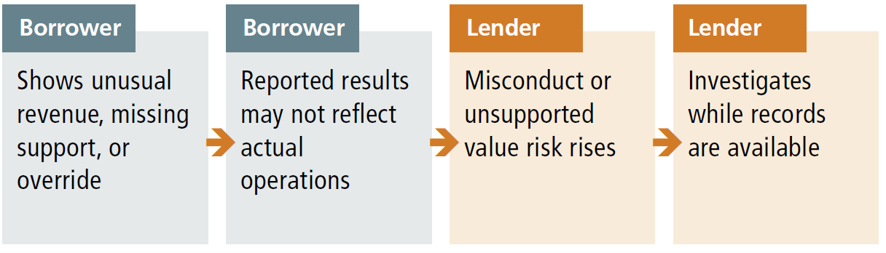
The value of independent forensic validation is not limited to matters in which fraud has already been alleged. Unreliable reporting, unsupported collateral, aggressive addbacks, hidden agreements, and undisclosed related-party transfers may reflect ordinary credit deterioration, weak controls, or intentional conduct. The forensic question is whether the pattern can be explained by stress and poor processes, or whether management is manipulating records, overriding controls, diverting cash, double-pledging assets, or creating transactions without a legitimate purpose. Testing that distinction early, while records, cash trails, and third-party evidence are still available, can protect collateral and preserve the lender’s available options.
Forensic analysis as private credit risk-management tool
The objective is not to investigate every borrower as though fraud has occurred. It is to incorporate independent validation into the credit lifecycle and to escalate when information cannot be reconciled, warning signs cluster, or the economic story no longer matches the evidence. A risk-based model may include:
Underwriting and prevention: define information and access rights before stress appears. Lenders can require reporting packages that include borrowing-base detail, loan-level data where relevant, bank and collection information, inventory support, related-party disclosures, amendment history, and access to records needed for targeted independent review. For higher-risk transactions, pre-closing forensic due diligence can help validate key information supporting the lending decision, while post-closing forensic review can round out the risk picture.
Monitoring and detection: test the facts, not just the ratios. Periodic or event-driven reviews can compare borrower reporting to source documents, customer remittances, lien records, servicer reports, bank activity, and operating data. The goal is to identify inaccurate reporting, collateral leakage, double-pledging risk, cash diversion, or other deterioration before liquidity collapses.
Response and recovery: move quickly when the story does not tie. Lenders can preserve records, increase reporting, conduct targeted forensic analysis, reassess collateral controls, trace value movement, engage with sponsors and advisors, and evaluate covenant or restructuring remedies while negotiating leverage remains.
Conclusion
Specialised forensic analysis is therefore not merely a post-default investigative tool to support claims against third-parties. Properly deployed during the underwriting, portfolio monitoring, and emerging distress phases, it helps lenders independently validate critical information before recovery options narrow. In modern private credit risk management, the lenders best positioned to preserve value are often those who corroborate independently and act before the borrower controls the only version of the facts.
*The views and opinions expressed are provided for general informational and educational purposes only and are subject to change without notice. This publication does not constitute investment, tax, or legal advice, nor should it be relied upon as a recommendation regarding any course of action. The information contained herein is provided “as is” without any representations or warranties as to its accuracy, adequacy, or completeness. While Hilco Trading, LLC has exercised reasonable care in preparing this publication, it assumes no liability for any actions taken or not taken based on its contents. Past performance is not indicative of future results.