Data Center Infrastructure Expansion, Energy Consumption and Related Considerations For Asset Based Lenders
November 2025
The evolution of artificial intelligence has reshaped the trajectory of data infrastructure. Typically reserved for cloud storage and IT solutions, data centers now form the backbone of the AI economy. Millions of data centers across the globe now run 24 hours a day, 7 days a week to maintain an exponentially increasing workload spurred on by AI demands. The computational requirements needed to train, deploy, and operate large language models, real-time inference systems, and support mechanisms are immense. These conditions have transformed the data center ecosystem into one of the most energy-intensive, capital-heavy, and strategically critical industries across global markets. This seemingly overnight transition has raised questions about scalability, sustainability, profitability, and valuation. This article explores the market implications of these facilities including an examination of the current state of the sector, including natural resource demand, infrastructure strategy, and emerging industry trends.
Energy Demands, Capacity, and Transmission Constraints
Data centers have quickly become one of the largest single-category users of electricity across the globe. In 2024, data centers consumed 415 terawatt hours (TWh), roughly 1.5% of global electricity usage. To put that into perspective, that figure equates to roughly 38 billion gallons of oil, enough to fill 60,000 Olympic-size swimming pools and power all international oceanic trade for 7 months. And this is just the beginning. Sectoral analysis forecasts the total power demand for data centers to double by 2030, with aggregate global demand surpassing 950 TWh. With new data center projects being announced weekly, regional and national power grids will need to match demand or face mounting concerns of grid bottlenecks and rolling blackouts.
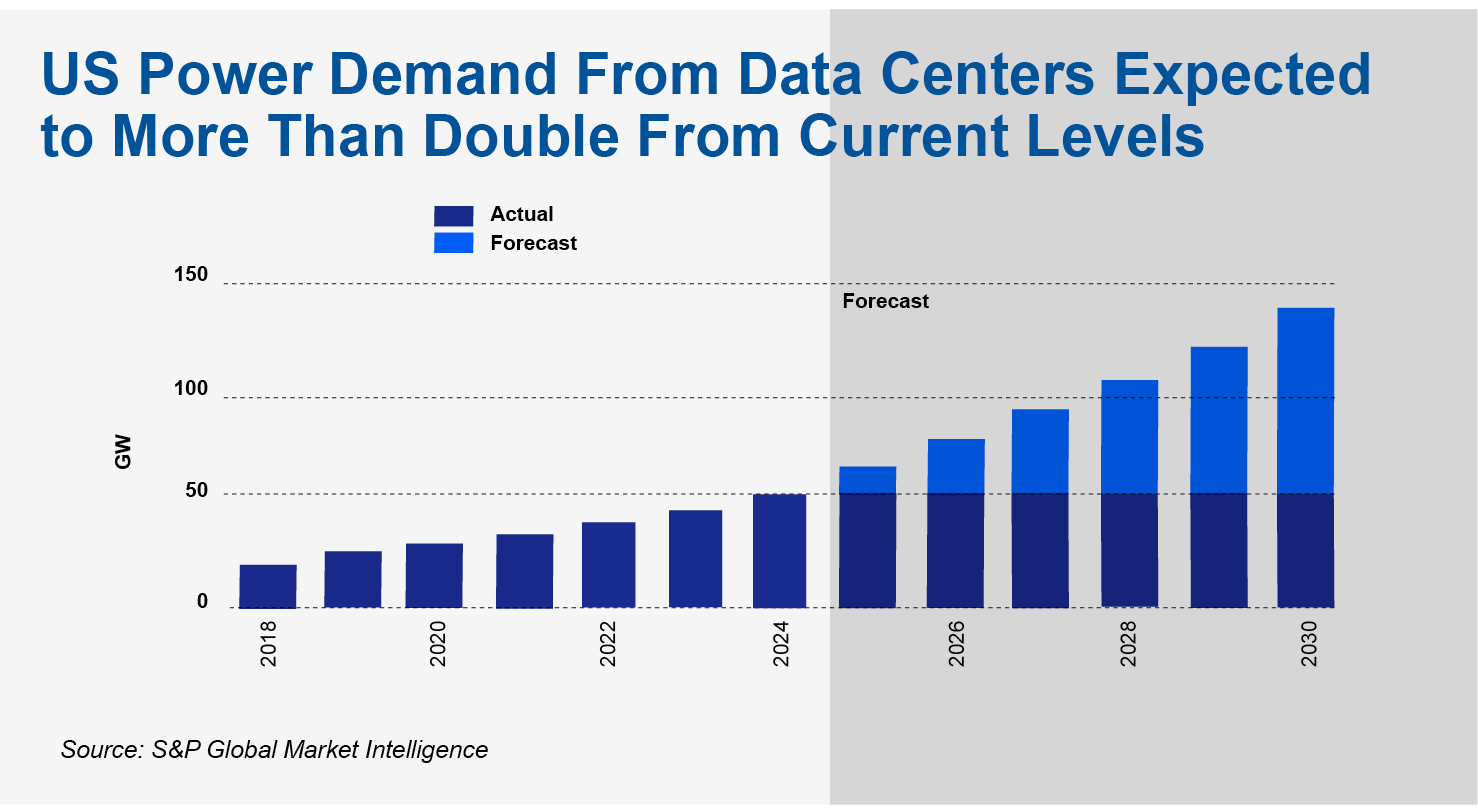
Concerningly, power providers face impending production and capacity issues due to the demands of artificial intelligence. Unlike traditional data storage, AI inference and training are intensely power-dense and unpredictable, creating inconsistent load patterns that exacerbate complications surrounding grid management. The effects are particularly noticeable on a regional scale. By 2030, data centers could account for 8–12% of total power consumption in the United States. Additionally, data center “clusters” have become the standard; that is, the construction of several facilities in one concentrated area. Leading tech companies have focused these clusters in areas like South Texas, Northern Virginia and California, which have subsequently encountered difficulties meeting existing power demand. The Meta “Hyperion” project in Louisiana underscores these mounting pressures. The facility requires a $3 billion upgrade to the regional grid in order to meet expected power requirements, with half the cost borne by taxpayers.
Transmission infrastructure and prospective upgrades represent a significant bottleneck. While data centers can move from groundbreaking to operation within two to three years, transmission and interconnection projects usually take anywhere from four to eight years before operational readiness is achieved. Utility providers in congested regions, as well as regions that already host data center clusters, have begun rejecting interconnection inquiries due to load constraints. These mismatched timelines accentuate a foundational challenge: power infrastructure development is not matching the pace of digital infrastructure development and innovation. Assuming the year-on-year uptick in data center power demands, the U.S. could face regional blackouts by the end of the decade.
Infrastructure and Power Sourcing Strategies
With power concerns at the forefront of developers’ minds, data center hyperscalers and colocation investors are diversifying how they source energy. The industry has seen several options emerge as popular alternatives to traditional methods:
- Grid Supplied and Renewable PPAs: Many operators remain reliant on traditional grid power, often augmented by power purchase agreements (PPAs). These are long-term agreements that secure operator access to specific power allotments and are popularly structured through renewable energy producers as a way to hedge against the potential volatility of grid output.
- On-Site or Co-Generation System: Hybrid configurations, like combining gas turbines, battery storage, waste heat recovery, and other renewable options, have become increasingly common. The co-generation process involves simultaneous power generation for both the data center and co-generation site, limiting reliance on external providers and guarding against widespread outages.
- Nuclear Power and Small Modular Reactors (SMRs): Nuclear energy has seen a resurgence during the data center boom. Due to its efficiency compared to other power sources, operators view nuclear energy as a viable way to support increasing power loads from AI operations. Microsoft’s purchase of the retired Three Mile Island nuclear plant in 2024 marked a watershed moment, showing a willingness to repurpose nuclear assets to meet anticipated computational demands.
The mounting momentum that we are now observing for renovating and retrofitting derelict or legacy power plants is understandable, given that many of these properties already possess crucial infrastructure, including substations, transmission lines, and zoning requirements. These factors make qualified sites ideal for new data center projects. For prospective investors, this shortens project timelines and capital deployment risk while avoiding the often-arduous permitting processes associated with greenfield sites. Amazon has taken the lead with this method, as redevelopment of the Birchwood Power Plant in Virginia for an 869-acre data center campus began in 2023.
Water Use in Data Center Operations
Aside from power, water is a vital input in data center operation. Cooling is the most common use case, with a 100-megawatt facility using up to 2 million liters of water per day through evaporative cooling systems. In 2024, the global aggregate usage of water for data center operations was 560 billion liters, a figure that is projected to double by 2030. This challenge is further compounded by data center location patterns, including the popularization of geographic clusters. Some of the most ambitious hyperscale projects, backed by Meta, Amazon, and NVIDIA, are being constructed in water-scarce regions like Louisiana, Arizona, and Texas. As a result, data centers frequently compete with agricultural and urban water users, drawing criticism from local communities and regulators. In response, data center operators are testing alternative cooling options to mitigate water usage concerns.
- Closed-loop cooling: As opposed to cooling the entire server room, closed-loop cooling directly targets servers, circulating air and coolant only in condensed areas that require it. This system is both cheaper and less energy intensive than open-loop cooling, but it demands a higher up-front cost.
- Greywater reuse: Reusing wastewater for industrial cooling has become a popular and sustainable method of reducing data center water footprints. The collection and usage of greywater for cooling applications limits the demand for potable water, minimizing the environmental impacts of data center operations.
- Underwater data centers: A relatively new strategy, submerged data centers have undergone testing in Scotland and China. By utilizing the natural cooling properties of deep ocean water, these facilities could avoid the need for additional coolants entirely. Microsoft’s Natick site in Scotland is powered by solar and wind energy, further reducing its environmental footprint and aligning with sustainability goals.
New Investments and Collaborations
The current data center investment ecosystem is characterized by extraordinary scale, rapid pace, and extended collaboration across sectors. Last year, global capital expenditure exceeded $455 billion, representing a 51% year-on-year increase. By 2030, aggregate global CapEx is expected to reach $1 trillion. Within the sector, capital deployment is heavily concentrated in the top of the market, with Meta, Microsoft, Amazon, Google, and NVIDIA accounting for over half of all global data center investment. Recent project announcements from industry leaders illustrate the current trajectory of the AI infrastructure market:
- In September of 2025, OpenAI and NVIDIA announced a strategic partnership to deploy an anticipated 10 gigawatts of AI data centers built on NVIDIA computing systems. This move represents several millions of graphic processing units used for next-generation AI data infrastructure. NVIDIA plans to invest up to $100 billion in OpenAI following the deployment of each gigawatt, with the first being expected for use in the second half of 2026. NVIDIA’s Rubin Vera, a top-end computing and graphics processing platform, will be utilized as the primary processor at these facilities.
- An investment coalition, including Blackrock, Abu Dhabi fund MGX, and Microsoft, recently acquired Texas-based firm Aligned Data Centers in a $40 billion deal. The Global AI Infrastructure Investment Partnership (GAIIP) aims at developing new data center facilities and expanding existing sites, mainly focusing on U.S.-based locations. Additionally, NVIDIA has agreed to support the GAIIP, offering subject matter expertise and signaling amplified inter-company collaboration across the industry.
- Meta remains a leader in data center construction and expansion, with its $1 billion+ Kansas City facility achieving full operational status in August of 2025. Plans to construct a 1,000-acre facility in El Paso, Texas, were unveiled in October, along with multi-billion-dollar projects already underway in Ohio and Louisiana, named “Prometheus” and “Hyperion,” respectively.
- Building on an already extensive U.S. network of data centers, Amazon Web Services (AWS) announced an additional $30 billion investment across Pennsylvania and North Carolina in June of 2025. $20 billion will be allocated to develop “AI innovation campuses” in Salem and Falls Townships, Pennsylvania. Richmond County, North Carolina, will receive the remaining investment in an effort to build out existing computing capacity in the region.
These recently announced initiatives collectively underscore the evolution of data centers from niche storage infrastructure to a central pillar of the rapidly evolving digital economy. The scale of capital deployments, representing hundreds of billions of dollars allocated across industry-driving hyperscalers and institutional investors, represents the growing computational demands of artificial intelligence and the recognition of data infrastructure as a strategic asset. The current crop of mega-projects and regional campuses highlights a convergence between AI innovation and traditional finance, as private equity interests and sovereign investors compete for long-term, high-yield exposure to the digital economy. This momentum points to a data center market entering a phase of industrial-scale buildout, distinguished by resource and capital intensiveness, heightened growth opportunities, and increasing global integration.
Lender/Investor Guidance for Working With Data Center Borrowers
- Prioritize Power Readiness – Verify energy supply, grid access, and redundancy plans before committing capital. Confirm PPAs, interconnection timelines, and on-site generation feasibility.
- Evaluate Tenant Stability – Focus on anchor tenants with long-term, take-or-pay contracts. Review lease structures, renewal trends, and exposure to high-density AI workloads.
- Incorporate ESG and Energy Efficiency – Require renewable sourcing, carbon reduction strategies, and real-time energy monitoring to meet regulatory and market expectations.
- Assess Site and Infrastructure Viability – Confirm power and fiber connectivity, evaluate climate and zoning risks, and ensure community and permitting readiness.
- Encourage Phased Deployment – Tie funding to construction milestones, pre-leasing targets, and utilization thresholds. Maintain conservative leverage and adequate contingencies.
- Verify Operational Competence – Ensure experienced operators, continuous monitoring, maintenance programs, and clear governance are in place.
- Monitor Technology and Market Shifts – Track emerging technologies, power density changes, and overbuild risks to protect asset value.
- Strengthen Oversight and Contingency Planning – Require regular operational and financial reporting, include step-in rights, and use independent experts for periodic asset reviews.