Navigating the USMCA Crossroads: What Lenders Need to Know Now

Introduction
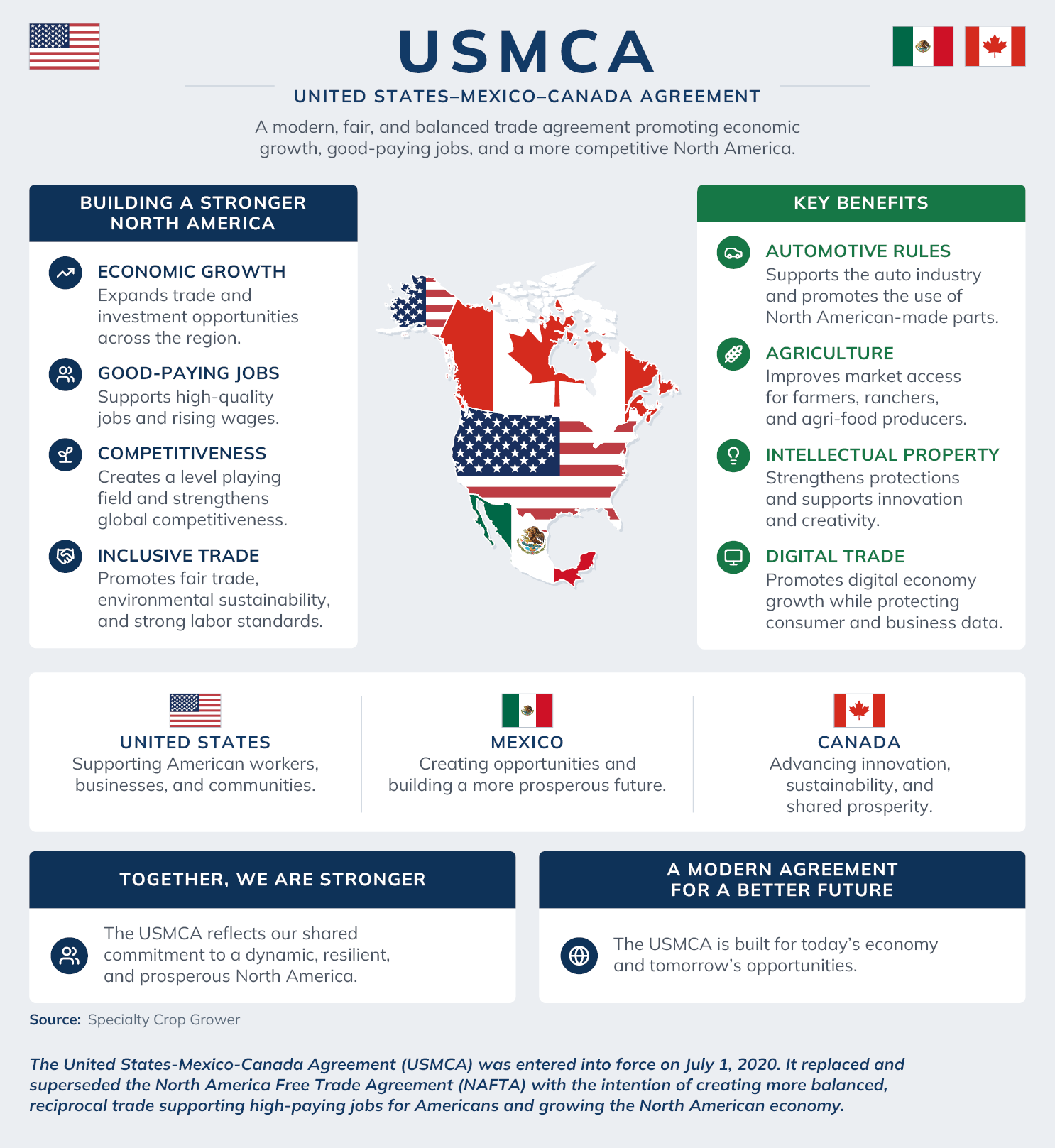
On July 1, 2026, the Free Trade Commission, comprising trade ministers from the United States, Mexico, and Canada, convened to make a decision that will shape North American commerce for the next decade. Under Article 34.7 of the United States-Mexico-Canada Agreement (USMCA), the three governments had to determine whether to extend the pact for sixteen years as written or allow the agreement to enter a cycle of annual reviews. On that date, the United States declined to renew the USMCA in its current form. This decision does not terminate the agreement—it remains fully in force through July 1, 2036—but it formally triggers a ten-year cycle of annual reviews and renegotiations, creating a prolonged period of uncertainty that will reshape how North American businesses forecast costs, plan capital investments, and manage supply chains.
What makes this outcome particularly challenging to navigate is not just the asymmetric manner in which the review unfolded before July 1, but the fact that the non-renewal decision now creates extended uncertainty through 2036. Rather than the unified trilateral process that the agreement’s architects envisioned, the United States effectively bifurcated the negotiation into two distinct bilateral tracks. The US-Mexico process moved with notable speed, with formal negotiating rounds launched in March 2026 and additional sessions scheduled through July. The US-Canada track, by contrast, lagged materially, leaving Canada’s economic position and the outlook for its exporters in a more uncertain posture.
For businesses operating across North American supply chains, particularly those in the automotive, steel, and manufacturing sectors, the July 1 decision means that cost forecasting, capital planning, and inventory management will remain extraordinarily difficult for the foreseeable future. For lenders with exposure to these borrowers, the implications are direct and will persist well beyond the date of the decision.
A Fractured Framework: From Trilateral To Bilateral
The USMCA was designed as a trilateral framework, but the 2026 review process took a markedly different shape. On March 18, 2026, the United States and Mexico formally launched the review bilaterally, without Canada present. The Center for Strategic and International Studies (CSIS) characterized this as a signal of Washington’s broader preference for country-by-country arrangements over regional integration, a shift with significant structural implications for how trade terms will ultimately be set and enforced across the continent. The US-Mexico discussions focused on domestic production requirements, limiting the role of non-market economies in regional supply chains, and tightening rules of origin for key industrial goods, with a third negotiating round scheduled for Mexico City in late July.
A significant development in February 2026 altered the tariff landscape in Mexico’s favor. The U.S. Supreme Court ruled, by a 6-3 vote, that the International Emergency Economic Powers Act (IEEPA) does not grant the President authority to impose broad-based tariffs unilaterally. Following this ruling, the Trump administration imposed a 10 percent global tariff on imports for up to 150 days (through July 24, 2026), but critically, goods qualifying under the USMCA remain exempt from these tariffs. According to BBVA Research, this framework allowed Mexico to maintain a relatively favorable tariff position compared with most countries, with an effective weighted average tariff rate of less than 7.0 percent for USMCA-compliant goods, compared to tariff rates ranging from 9.3 percent to 45.4 percent for other major trading partners.
Canada’s experience was notably different. While Canada formally requested a USMCA renewal ahead of the July review, engagement between Washington and Ottawa progressed more slowly. Canada’s posture throughout this period was more assertive, with officials and business leaders actively pursuing diversification of export relationships, including renewed engagement with China and other non-US partners, as a hedge against dependence on the American market. This strategic pivot reflected a recognition that the bilateral framework being advanced by Washington might deliver less favorable terms for Canada than the original trilateral architecture.
CSIS noted that the most durable outcome for both Canada and Mexico would come from acting jointly within a trilateral framework, as this preserves collective leverage and avoids the risk of being picked off in sequential bilateral negotiations. Whether that coordination materializes in future annual reviews remains to be seen.
The Business Uncertainty Problem
For manufacturers, logistics operators, and any enterprise whose cost structure depends on cross-border movement of goods, the inability to forecast the post-July tariff and rules-of-origin environment had been showing up directly in investment decisions, inventory management, and financial performance even before July 1. That damage continues to accumulate on balance sheets across both countries, and the July 1 non-renewal decision means it will likely persist.
The data from Canada is unambiguous. TD Economics, in its Canadian Quarterly Economic Forecast published in March 2026, noted that private non-residential investment contracted by 0.3 percent in 2025 as US tariffs weighed heavily on business confidence, and characterized the 2026 outlook as “not materially better.” The Bank of Canada Development Corporation (BDC) projects Canadian GDP growth of only approximately one percent in 2026, down from an already subdued 1.2 percent in 2025, with trade tensions explicitly cited as a primary drag. RBC Chief Economist Frances Donald noted that ongoing trade disruption “weighs on business investment” in both economies, and RBC chief executive Dave McKay publicly acknowledged during bank earnings commentary that uncertainty around the USMCA review was preventing his institution from providing firm forward guidance to clients, a striking admission from the country’s largest bank. With the July 1 decision now confirmed, that uncertainty will extend through annual review cycles for the next decade.
The scale of the challenge is most visible in the automotive sector, which sits at the intersection of nearly every contested element of the USMCA review: rules of origin, domestic content thresholds, steel and aluminum tariffs, and Chinese investment concerns. According to data cited by Automotive News, global automakers collectively incurred approximately $35.4 billion in tariff-related expenses in 2025 alone. Toyota projected tariff costs of $9.1 billion for its fiscal year ending March 2026, while General Motors, Ford, and Stellantis together reported a combined $6.5 billion in 2025. Tariffs on the automotive industry resulted in a 7.3 percent decline in U.S. purchases from Mexico, although Mexico’s market share in automotive exports to the U.S. remained unchanged, reflecting the industry’s dependence on North American production networks despite tariff pressure. In Mexico, the Automotive Industry Association (AMIA) characterized continued Section 232 tariffs on vehicle exports as “the worst-case scenario for Mexico,” and data from Mexico’s national statistics agency INEGI showed that exports to the United
States declined 4.4 percent year over year in February 2026.
However, Mexico has diversified its export portfolio to partially offset automotive sector weakness. According to BBVA Research, while tariffs pressured automotive exports, the opposite occurred in agriculture and basic metals, where Mexico expanded its market share. Six industries—computing and electronics, transportation equipment, chemicals, machinery and equipment, basic metals, and electrical equipment—now account for 65.2 percent of U.S. imports in 2025, and Mexico leads in four of these sectors, strengthening its competitive advantage over both China and Canada in high-value manufacturing, except in chemicals and basic metals.
For individual companies, these macro pressures translate into very specific operational challenges. Auto parts suppliers have faced direct disruption from the tariff environment, as input costs, cross-border logistics, and customer production schedules have all become moving targets. When a business cannot forecast its cost of goods sold with reasonable accuracy, its ability to service debt, maintain covenant compliance, and manage working capital is fundamentally compromised. This is the environment in which lenders with exposure to these sectors are now operating—an environment that will persist as annual reviews and renegotiations unfold.
Two Divergent Responses
While both Canada and Mexico are navigating the same upstream uncertainty, the strategies they have adopted and the vulnerabilities they carry differ meaningfully, a distinction that has direct relevance for lenders assessing cross-border credit exposure.
Canada enters this extended review cycle in a structurally weaker position than it occupied during the last major tariff wave. BMO Capital Markets’ 2026 economic outlook identified Ontario, the heart of Canada’s manufacturing economy, as the province most exposed to US trade friction, running growth well below the national average. TD Economics’ provincial forecast noted that sector-specific tariff measures are placing a drag on lumber, base metals, and manufacturing more broadly, while the ongoing annual USMCA reviews will keep investment uncertainty elevated. Canadian businesses, particularly those in auto parts and steel, are operating with thinner margins and less financial resilience than they did entering the 2018-2019 NAFTA renegotiation, a point that has significant implications for collateral quality and borrower creditworthiness.
Mexico’s situation is more nuanced. The country has adopted a deliberately cooperative posture in its negotiations with Washington, aligning on tariffs for Chinese goods and positioning itself as a compliant partner on supply chain security. This approach has preserved Mexico’s access to the US market for USMCA-compliant exports, which currently enter duty-free and cover approximately 50 percent of Mexico’s total US-bound exports.
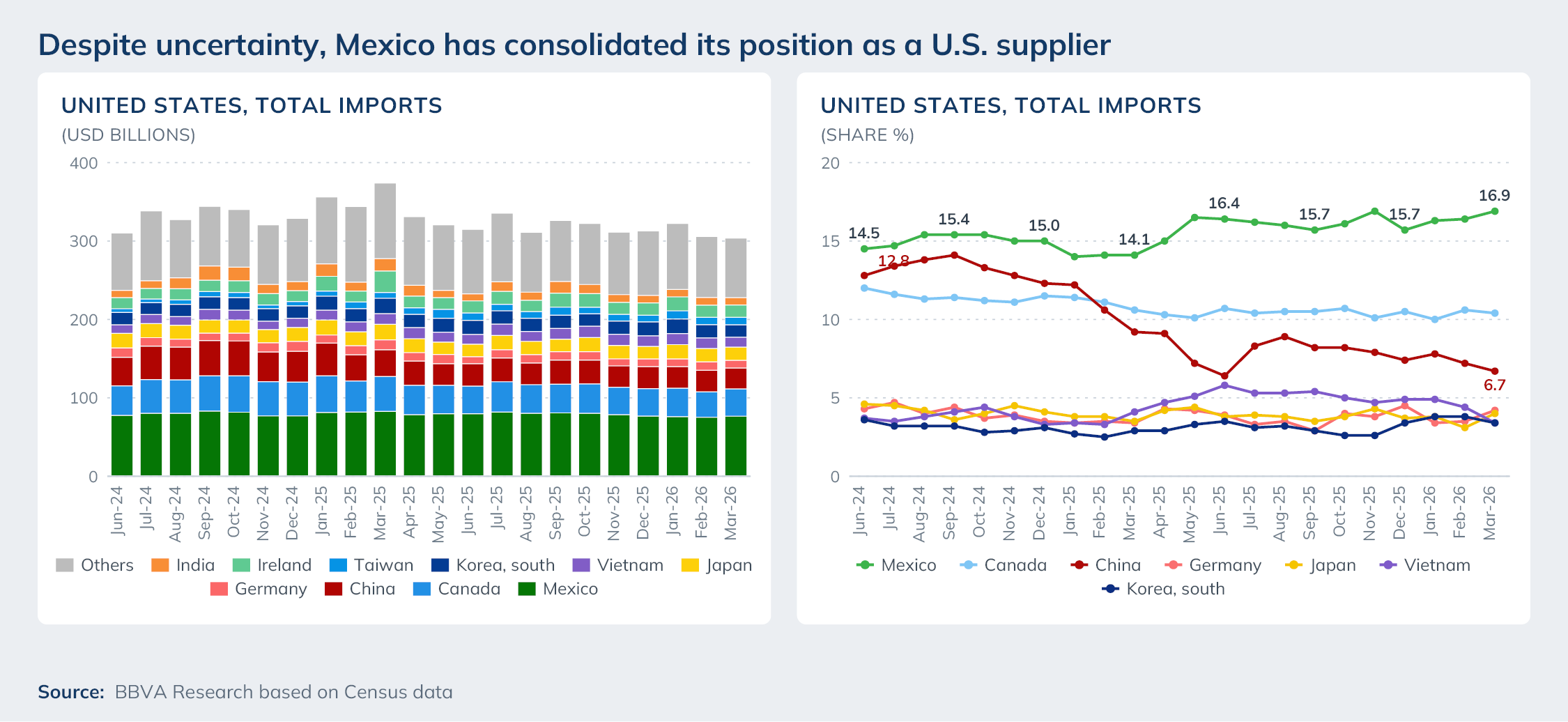
U.S. imports from Mexico reached $534.9 billion in 2025, a 5.8 percent year-over-year increase, consolidating Mexico as the primary U.S. trade partner, supplying 15.0 percent of total U.S. imports. The depth of this commercial relationship—and the incentive structures supporting it—remains a stabilizing force as the annual USMCA review process unfolds.
However, Mexico’s automotive sector, historically its most important manufacturing industry, faces a structural threat from a different direction. Chinese vehicle imports now constitute approximately 30 percent of Mexico’s total car market, according to the Baker Institute for Public Policy, and the continued presence of Section 232 tariffs operating outside the USMCA framework is imposing severe costs on existing manufacturers. The uncertainty surrounding how the ongoing annual USMCA reviews will address these dynamics will likely continue to suppress manufacturing investment across Mexico, as it did throughout 2025.
This dynamic became concrete in mid-July 2026, when Toyota confirmed it will shift part of its Tacoma pickup production from Baja California to a $3.6 billion expansion in San Antonio, Texas — though the company’s Guanajuato plant, per Mexico’s Ministry of Economy, remains unaffected. President Claudia Sheinbaum announced a third meeting with automakers to explore mechanisms to prevent further plant closures or relocations, while confirming that bilateral talks with Washington aimed at reducing sector-specific tariffs remain ongoing. The Toyota move echoes a pattern seen since 2024, when Elon Musk indefinitely paused Tesla’s $5 billion Nuevo León gigafactory, citing the same underlying risk — tariff threats on vehicles manufactured in Mexico — as a reason not to commit further capital. Two years later, that same uncertainty continues to shape investment decisions across the sector.
The Outlook: Annual Reviews and Extended Uncertainty Through 2036
The July 1, 2026 decision has created a scenario that CSIS described as a “cloud of sustained uncertainty that discourages long-term investment bets on North America.” For businesses dependent on cross-border supply chains, this outcome is the most challenging: the agreement survives, but the inability to plan beyond a twelve-month horizon erodes capital formation, suppresses new facility investment, and makes multi-year borrowing structures significantly more complex to underwrite. The tariff treatment, rules of origin requirements, and market access provisions that underpin current cross-border manufacturing operations remain in effect, but their permanence is no longer assured.
This uncertainty will not be resolved by any single negotiation. Instead, businesses and lenders must prepare for a decade in which annual reviews and the possibility of divergent bilateral arrangements create recurring decision points and recurring disruption. The trilateral framework that had provided coherence to North American trade for six years is now in a state of prolonged renegotiation, with no guaranteed resolution before 2036.
Canada’s Department of Finance, in its Spring Economic Update 2026, offered a characteristically understated summary of where things stand: “risks around the outlook are unusually high.” Coming from a government fiscal document, that is not boilerplate. It is an acknowledgment that even the most informed institutional forecasters cannot assign high confidence to the trajectory of trade policy or economic performance over the next decade.
Mexico and the United States concluded the third bilateral USMCA review round on July 23, where Mexico proposed six priorities issues or items for focus of negotiations, including a protocol against unilateral tariffs and for preserving automotive competitiveness in North America. Confirmed outcomes included duty-free treatment for roughly 85% of Mexican exports and an assurance that Washington’s shift from Section 122 to Section 301 tariffs would not alter Mexico’s terms; a partial answer to fears that the review process could otherwise hand Washington open-ended tariff authority. Fitch and S&P, however, still flag the annual-review pattern as a source of lingering investor uncertainty.
Not all recent signals point toward retrenchment, however. President Sheinbaum has indicated that an as-of-yet-unnamed automaker is expected to announce plans to establish a new plant in Mexico within the coming weeks — a reminder that, even amid sustained policy uncertainty, fresh capital continues to view the country as a viable long-term manufacturing base.
Lender Guidance
For lenders with exposure to businesses operating across North American supply chains, the July 1 decision formalizes an environment that demands a more active and analytically rigorous approach to portfolio management than a benign trade environment would require. The uncertainty that had been suppressing business investment and complicating corporate planning before July 1 will now persist through an annual review cycle that extends through 2036. Collateral and covenant structures that underpin existing credit facilities must be evaluated not for a single outcome, but for the possibility of recurring disruptions.
The first priority is collateral visibility. In an environment where tariff costs are restructuring production economics for manufacturers, the stated book value of assets, particularly inventory, machinery and equipment, and accounts receivable, may not accurately reflect realizable value under stress. Inventory valuations for companies with significant cross-border supply chain exposure can shift materially as tariff regimes change or remain in flux, and receivables portfolios backed by trade customers facing their own margin compression carry elevated concentration risk. Lenders should be seeking current, market-based appraisals from advisors with proven expertise in the specific country and sector context, not relying on desktop updates to pre-tariff assessments.
The second priority is borrower-level stress testing under sustained uncertainty. For companies in the automotive, steel, and manufacturing sectors in particular, lenders should be modeling covenant performance under scenarios of prolonged annual reviews and potential tariff regime changes. The rationale for this is not to predict which specific outcome will occur, but to better understand at what point a credit facility designed for a stable trade environment begins to develop structural weaknesses when faced with a decade of recurring policy uncertainty. This is especially important for Canadian borrowers, whose weaker financial footing relative to the last tariff cycle creates less cushion between current performance and covenant breach thresholds.
The third priority is understanding where liquidity options exist when conventional lenders pull back. Major US banks have historically been cautious about extending asset-based lending into Canada and Mexico, particularly in periods of elevated trade uncertainty. That caution creates gaps, and it is precisely in those gaps where Hilco Global has built its practice. Hilco’s asset-based lending capabilities are specifically designed to leverage assets, including accounts receivable, inventory, real estate, machinery and equipment and intellectual property, in both core markets and markets where larger institutions are unwilling or unable to operate with the required level of local expertise and boots on the ground. This is not a peripheral capability for Hilco; it is the core of what we do, and it is what makes us genuinely useful to lenders navigating credits in Canada and Mexico during this period of extended uncertainty.
Beyond direct lending, Hilco’s advisory capabilities, spanning appraisals, commercial due diligence, receivership services, and full asset monetization, provide lenders with the independent, operationally grounded insight they need to make informed decisions about distressed or pressured credits. As supply chains diversify in response to trade uncertainty, with companies moving production to locations in Europe, Asia, and beyond, Hilco’s global reach, including established operations in markets such as Belgium and Australia, ensures that lenders are not limited by geography in their ability to understand and realize asset value.
The USMCA will be subject to annual reviews through 2036. What lenders cannot afford is to treat the period ahead as a waiting room in which decisions are deferred until clarity emerges. The businesses most exposed to this uncertainty are under pressure today, and the value of independent appraisal, diligence, and advisory support is highest before a credit deteriorates, not after. Lenders who act now will have options. Those who wait for certainty may find the choices have narrowed considerably.
About Hilco Global
Hilco Global is a diversified financial services company that delivers integrated professional services and capital solutions helping clients maximize value and drive performance across the retail, commercial industrial, real estate, manufacturing, brand and intellectual property sectors, and more. Hilco Global provides a range of customized solutions to healthy, stressed, and distressed companies to resolve complex situations and enhance long-term enterprise value.
With established operations across North America and internationally, Hilco Global is uniquely positioned to assist lenders and businesses navigating the complexities of cross-border asset-based finance, including in markets such as Canada, Mexico, Belgium, and Australia where major US institutions often lack the local expertise required to act decisively. Hilco Global, a subsidiary of ORIX Corporation USA, works to deliver the best possible result by aligning interests with clients and providing strategic advice and, in many instances, the capital required to complete the deal.
*The views and opinions expressed are provided for general informational and educational purposes only and are subject to change without notice. This publication does not constitute investment, tax, or legal advice, nor should it be relied upon as a recommendation regarding any course of action. The information contained herein is provided “as is” without any representations or warranties as to its accuracy, adequacy, or completeness. While Hilco Trading, LLC has exercised reasonable care in preparing this publication, it assumes no liability for any actions taken or not taken based on its contents. Past performance is not indicative of future results.