Pressure Points: What ABL Lenders Need to Know About North America’s Plastics Market

The North American plastics market is in a difficult stretch, and the forces driving that difficulty are not short-term fluctuations. A structural imbalance between supply and demand has built up over several years, and it is now intersecting with an aggressive shift in China’s role as a global market player. For lenders with exposure to plastics producers, compounders, distributors, or converters, the combination warrants a much closer look at borrower fundamentals and collateral assumptions.
This article lays out the key dynamics at work across the supply and demand landscape, explains the two-sided threat that China now presents to North American operators, and offers practical guidance for ABL lenders seeking to limit their downside risk across the chemicals and plastics supply chain.
The Supply Problem: Too Much of a Good Thing
For well over a decade, North American plastics producers have operated from a position of genuine competitive strength. Access to cheap, shale-gas-derived ethane and propane feedstocks gave Gulf Coast producers a structural cost advantage over rivals in Europe and much of Asia. That advantage fueled a wave of capacity investment, particularly in polyethylene (PE) and polypropylene (PP), the two most widely used commodity resins in the world.
The problem is that the buildout did not stop when the market reached equilibrium. It kept going. According to Chemical Market Analytics by OPIS, cumulative excess PP supply over demand reached approximately 19 million metric tons between 2020 and 2024, with an additional 7 million metric tons of excess incremental supply in 2024 alone. For PE, a similar dynamic has played out, with North American production growth consistently outpacing domestic consumption.
Because domestic demand cannot absorb what North American plants produce, producers have leaned heavily on exports to keep utilization rates viable. The U.S. Energy Information Administration reported that U.S. exports of ethane and ethane-derived petrochemicals, including PE grades, reached an all-time high of 21.6 million metric tons in 2023, a 134 percent increase since the country first began exporting ethane in 2014. According to Argus Media, nearly all PE production growth in 2024 came from North America, with most of the surplus directed toward export markets, elevating North American PE exports to record levels.
The irony is that by exporting cheap raw materials and neat resins at scale, North American producers have effectively helped foreign converters and compounders achieve competitive input costs. The structural advantage that justified the original capacity investment is, in part, being exported along with the product.
The Demand Side: Flat to Negative in Key End Markets
While the supply side has expanded, demand growth has been consistently disappointing. Packaging remains a relatively stable baseline, accounting for more than half of typical polymer demand, but the end markets that drive volume growth have been weak.
Automotive:
Engineering resins including Nylon 6 and 66, polycarbonate (PC), and ABS depend heavily on vehicle production volumes. Year-over-year production declines and a slower-than-expected transition to electric vehicles have depressed demand for these grades. The automotive sector’s demand for PP has also softened, as OPIS data shows North American PP operating rates hovering in the 70 to 80 percent range in recent periods, well below the levels that support healthy producer margins.
Construction and appliances:
Residential housing starts have remained sluggish under persistent credit tightening, dragging down demand for polyvinyl chloride pipe, PE films used in construction applications, and a range of other materials tied to home building and renovation. Consumer spending on durable goods has similarly pulled back, reducing volumes for appliance-grade engineering resins.
Distributor behavior:
Rather than building inventory ahead of anticipated demand, converters and distributors across the supply chain have adopted tight, just-in-time purchasing patterns. This reflects a deliberate effort to avoid holding inventory that may continue to decline in value. For lenders, this behavior matters because it compresses the receivables cycle and can mask underlying demand weakness in a borrower’s top-line revenue figures.
The China Factor: A Two-Front Challenge
China’s role in the global plastics market has fundamentally changed. What was once the world’s largest net importer of North American polyolefins is now both a formidable domestic producer and an aggressive exporter of finished and semi-finished plastic goods.
Rapid domestic capacity build-out:
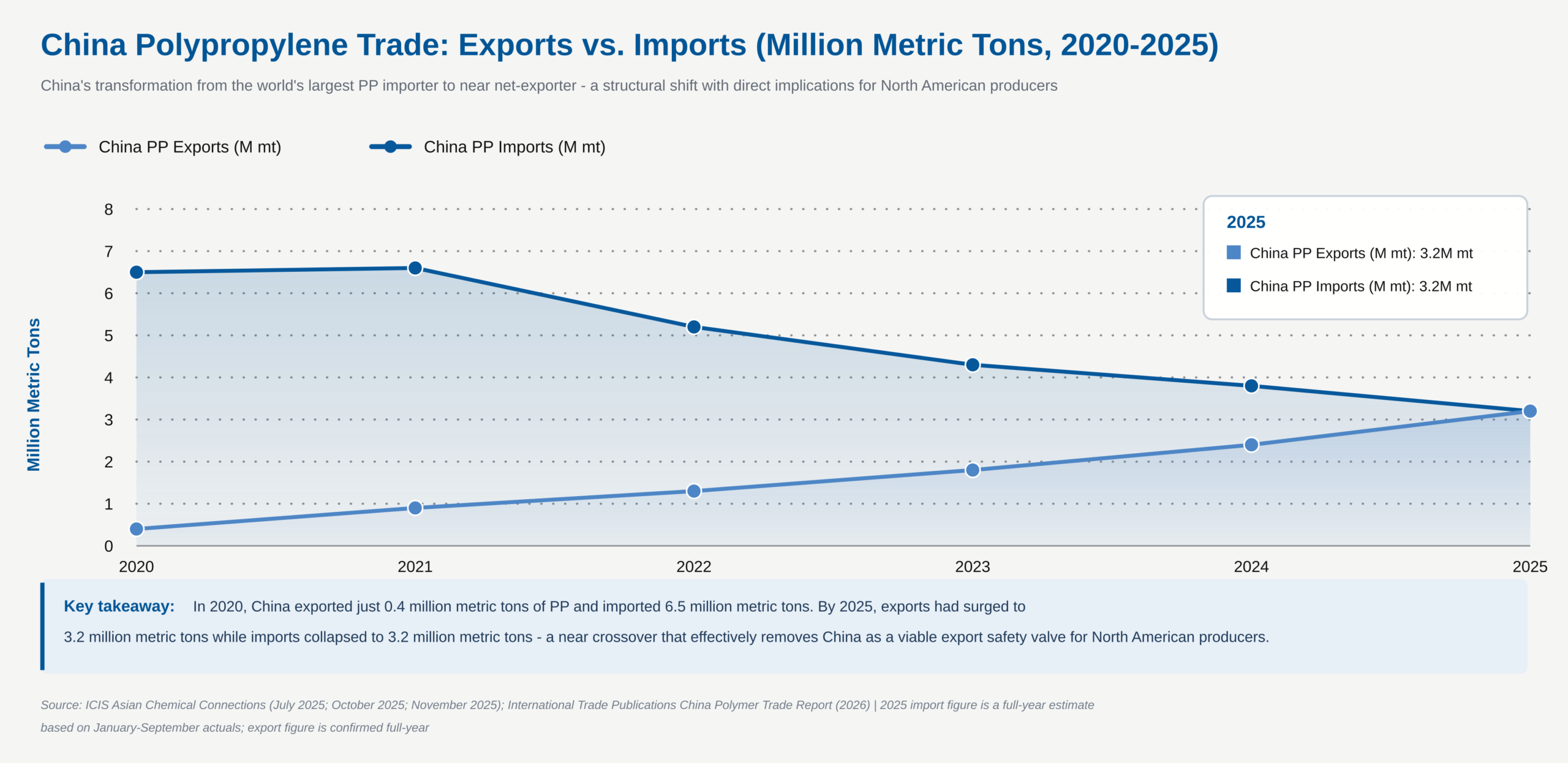
China added approximately 6.7 million metric tons of new PP capacity in 2025 alone, bringing total domestic capacity to the point where it now exceeds local demand by an estimated 22 million metric tons, according to ICIS data and projections reported late last year. That surplus is forecast to peak at 28 million metric tons by 2028. The practical effect is already visible in trade flows: China’s PP exports reached an estimated 3.2 million metric tons in 2025, up from 2.4 million metric tons in 2024 and a mere 400,000 metric tons as recently as 2020, while total Chinese PP imports collapsed to roughly 3.2 million metric tons, less than half of the 6.6 million metric tons imported in 2021.
The strategic intent is clear. China has invested heavily in domestic petrochemical self-sufficiency to reduce its dependence on imported raw materials, and those investments are now bearing fruit. North American producers can no longer count on China as a large and reliable export destination to absorb surplus volumes.
Anti-dumping duties closing the China export door:
Beyond self-sufficiency, China has actively erected barriers to protect its domestic industry from foreign competition. In May 2025, China’s Ministry of Commerce announced anti-dumping duties of up to 74.9 percent on POM copolymers, a widely used engineering plastic, imported from the United States. European shipments face 34.5 percent duties, and Japanese imports are subject to 35.5 percent rates. The investigation that led to these duties was launched in May 2024 in direct response to U.S. tariff escalations on Chinese goods. The effect is to further close one of the few remaining large export markets available to North American specialty resin producers.
The finished goods inundation:
Facing slowing domestic economic growth, Chinese manufacturers have redirected production capacity toward export markets. Finished and semi-finished plastic products, including polyethylene films, thermoformed packaging, and compounded resins, are moving into North America in growing volumes. According to the Observatory of Economic Complexity, China’s year-on-year exports of plastic products increased 14.2 percent as of May 2026. Imported engineering resins from Asia are regularly priced 10 to 15 percent below domestic North American market levels, according to market participants tracked by Star Plastics, putting sustained downward pressure on margins for domestic compounders and distributors.
What This Means for Asset Values and Collateral
The combination of overcapacity, tepid domestic demand, and intensifying import competition creates a distinctly more difficult operating environment for plastics sector borrowers. For ABL lenders, three risk areas stand out.
Margin compression at multiple points in the supply chain:
Producers face compressed realized margins as export markets tighten and domestic spot prices face downward pressure from import competition. Compounders and processors face input cost volatility driven by tariff uncertainty while simultaneously competing against lower-cost Asian finished goods. Distributors are caught between buyers insisting on just-in-time purchasing and inventory they cannot move at historical price levels. Across the supply chain, the margin cushion that historically supported borrowing base calculations is thinner than it appears on recent financials.
Inventory devaluation risk:
Global polyolefin and engineering resin capacity is projected to outpace demand well into the latter part of this decade. That structural oversupply creates a genuine risk of pricing corrections that do not follow historical seasonal patterns. Lenders relying on historical regional spot price floors to establish recovery assumptions for resin and compound inventory need to recalibrate. Accurate valuation in this environment requires analysis of global trade flows, Chinese export pricing, and current tariff conditions, not just domestic benchmark comparisons.
Trade and tariff volatility creating sudden price swings:
The tariff environment has introduced a new source of price risk that does not behave like traditional market cycles. Engineering resins for which the U.S. relies on imports for a meaningful share of supply, including some grades of polycarbonate and ABS, are particularly exposed to sudden price dislocations when tariff conditions shift. The American Chemistry Council has estimated direct cost increases of 12 to 20 percent for plastics processors dependent on imported raw materials as a result of recent tariff actions. Borrowers in this category may face margin compression that appears suddenly and is difficult to pass through to customers quickly.
A Framework for Lender Risk Management
Current global market conditions require a heightened focus on disciplined diligence and more frequent monitoring. The following guidelines can help lenders with existing or prospective exposure to effectively manage risk.
Revisit inventory eligibility and advance rate assumptions:
Standard advance rates on finished goods and raw material resin inventory were developed in a different price environment. Given the structural risk of pricing corrections, lenders should review their eligibility criteria for commodity resin grades and consider whether advance rates for slow-moving grades, single-customer compounds, or highly specialized engineering resins adequately reflect liquidation risk in today’s market. An independent appraisal from a firm with direct market knowledge of current resin pricing and Chinese import competition is advisable before renewing or extending facilities.
Stress test borrowing bases against realistic downside price scenarios:
Historical NYMEX or spot price floors are not a reliable guide to liquidation value in a structurally oversupplied global market. Borrowing base stress tests should incorporate a realistic downside scenario that assumes further erosion in domestic resin prices driven by continued Chinese export pressure. A 15 to 25 percent price reduction scenario for commodity grades is a reasonable planning assumption given current global capacity projections.
Monitor export revenue concentration in producer borrowers:
For lenders with exposure to North American PE or PP producers, the share of revenue dependent on export markets is a key risk metric. As OPIS and Argus data confirm, export dependency has increased significantly as domestic demand has stagnated. Borrowers with heavy export exposure face greater vulnerability to tariff retaliation, freight disruption, and foreign market conditions that are increasingly unpredictable. Loan agreements should require regular disclosure of export market composition and flag concentration above agreed thresholds.
Distinguish between commodity and specialty or engineered grades:
Not all plastics borrowers carry the same risk profile. Producers and processors focused on highly specified engineering grades for medical, aerospace, or defense applications typically face less direct price competition from Chinese imports. Commodity PE, PP, and standard ABS or PC compounds are far more exposed. Underwriting should reflect this distinction clearly, with tighter advance rates and more frequent reporting requirements for borrowers concentrated in commodity grades.
Increase monitoring frequency for converters and distributors:
The just-in-time purchasing behavior now prevalent across the supply chain means that inventory levels and receivables balances can shift materially in a short period. Monthly borrowing base certificates may not provide adequate early warning in this environment. Lenders should consider requiring more frequent reporting from borrowers with significant inventory concentrations, and should track days inventory outstanding as a leading indicator of pricing or demand stress.
Maintain awareness of the tariff calendar:
The current tariff environment is genuinely fluid. Anti-dumping investigations, Section 301 actions, and retaliatory measures can all change the economics of specific resin grades quickly and without much advance notice, as the May 2025 POM copolymer duties demonstrated. Lenders with concentration in engineering resin borrowers should maintain an active awareness of ongoing trade investigations that could affect the cost structure or competitive position of those borrowers.
The North American plastics market is not in crisis, but it is in a period of sustained structural stress that is unlikely to resolve quickly. The capacity that was built during the shale boom does not disappear, and China’s domestic petrochemical investment is not going to reverse. Lenders who approach this sector with updated assumptions, sharper collateral analysis, and more active monitoring will be better positioned to support their borrowers through the cycle and to protect their own portfolios in the process.
Hilco Global is the leader in valuation services for the chemical industry, with hundreds of highly accurate appraisals delivered on asset values ranging from $10 million to over $1 billion. The Hilco Global Valuation team frequently works hand-in-hand with other Hilco experts including those within our Strategic and Operational Advisory to provide cross-functional Manufacturing Operations, Supply Chain, People, Mergers & Acquisitions, and Commercial expertise to the chemical and other industries. By teaming highly regarded industry veterans with advisory experts, we are uniquely positioned to deliver optimal solutions that assist businesses in achieving favorable outcomes under a wide range of market conditions and circumstances.
*The views and opinions expressed are provided for general informational and educational purposes only and are subject to change without notice. This publication does not constitute investment, tax, or legal advice, nor should it be relied upon as a recommendation regarding any course of action. The information contained herein is provided “as is” without any representations or warranties as to its accuracy, adequacy, or completeness. While Hilco Trading, LLC has exercised reasonable care in preparing this publication, it assumes no liability for any actions taken or not taken based on its contents. Past performance is not indicative of future results.